How to learn the constellations
Start with one bright pattern you cannot miss, use it as a signpost to its neighbours, and come back a month later: the sky will have turned, and you will know a little more of it.
A constellation today is not a picture but a region of the sky. The International Astronomical Union (IAU) recognises 88 constellations, with boundaries drawn by the Belgian astronomer Eugène Delporte and adopted in 1928, so that every star belongs to exactly one of them. The familiar star patterns, such as the Big Dipper or Orion’s belt, are the signposts inside those regions. Learning the sky means learning a dozen of these signposts and the routes between them.
How the sky moves
Two motions matter:
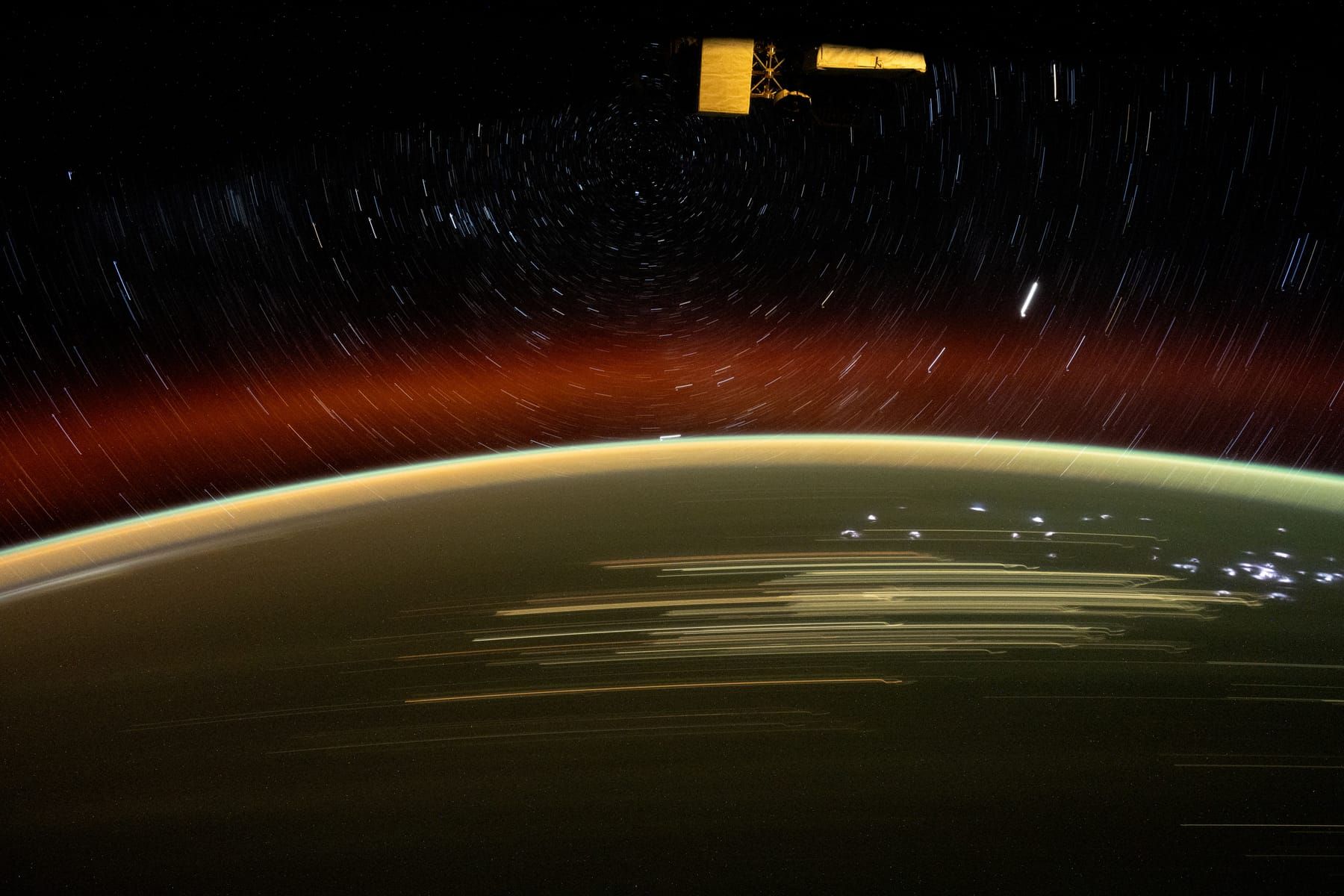
- Through the night: the sky turns around the celestial pole once a day, because Earth rotates. In the northern hemisphere the pole is marked closely by Polaris, the Pole Star. Stars near it circle without setting, and stars far from it rise in the east and set in the west.
- Through the year: because Earth orbits the Sun, each star rises about four minutes earlier every night. After a month the sky at a given hour has turned by two hours, and after a year it is back where it started. That is why there are winter and summer constellations.
The 3D sky shows this: set any date and time for your location and the stars are where they will really be.
Find your anchor
In the northern hemisphere, start with the Big Dipper (part of Ursa Major), seven bright stars in the shape of a saucepan. It is visible on every clear night from most of Europe and the northern United States and Canada. Farther south it dips below the northern horizon on autumn evenings. The two stars at the end of the pan, the “pointers”, point to Polaris, which marks north and your latitude: its height above the horizon in degrees equals your latitude. Polaris is the end of the handle of the Little Dipper (Ursa Minor). Following the curve of the Big Dipper’s handle leads to the bright orange star Arcturus in Boötes, and on to Spica in Virgo.
In the southern hemisphere, start with Crux, the Southern Cross, and the two bright “pointer” stars of Centaurus next to it. The long axis of the cross points towards the south celestial pole, which has no bright star.
Season by season
For an observer at mid-northern latitudes, in the evening sky:
| Season | Learn these first | Signposts |
|---|---|---|
| Winter | Orion, Taurus, Gemini, Canis Major | Orion’s three-star belt points down-left to Sirius, the brightest star, and up-right to Aldebaran and the Pleiades cluster |
| Spring | Leo, Boötes, Virgo | The Big Dipper’s handle arcs to Arcturus, then to Spica, and Leo’s “sickle” looks like a backwards question mark |
| Summer | Lyra, Cygnus, Aquila, Scorpius | Vega, Deneb and Altair form the Summer Triangle overhead, and Scorpius with red Antares lies low in the south |
| Autumn | Pegasus, Andromeda, Cassiopeia | The Great Square of Pegasus, and Cassiopeia’s W opposite the Big Dipper across the pole |
In the southern hemisphere the seasons are reversed and the northern constellations appear upside down.
Tips
- Use a planisphere or the 3D sky, not a photo. Photos show far more stars than the eye, which makes patterns hard to recognise. Set the sky view to the hour you are outside and compare.
- Learn magnitudes. From a town you may see only stars brighter than magnitude 3 or 4, so patterns made of fainter stars disappear. See the magnitude guide and the light pollution guide.
- Hold your hand out. At arm’s length, a fist spans about 10°, a spread hand about 20°, a finger about 1° (a common rule of thumb). The Big Dipper is about 25° long.
- The ecliptic. The Sun, Moon and planets move along one band of the sky, the ecliptic, through thirteen constellations: the twelve of the zodiac plus Ophiuchus. The Moon and planets stray a little farther and can also appear in Cetus, Orion, Sextans and Auriga. A bright “star” that is not on your map and sits on that band is a planet. See how to find the planets.
Sources
- International Astronomical Union: The Constellations (the 88 constellations, the 1922 list, the 1928 boundaries, abbreviations)
- Areas and star membership on this site are computed from the IAU boundaries (see the constellation pages)
- Star data on this site: HYG Database v4.4 (see data sources)
Frequently asked questions
How many constellations are there?
88. The International Astronomical Union adopted the list in 1922 and the boundaries between them in 1928, so every point of the sky belongs to exactly one constellation. The largest is Hydra (about 1,300 square degrees), the smallest Crux, the Southern Cross (about 70).
Why do the constellations change with the seasons?
Earth goes round the Sun once a year, so the night side of Earth faces a different part of the sky each season. Any star rises about four minutes earlier each night, which adds up to two hours a month and a full turn in a year.
Can I see the same constellations from the southern hemisphere?
Partly. Constellations near the celestial equator, such as Orion, are visible from both hemispheres, though upside down in one of them. Those near the poles are visible from one side of the Earth only: Ursa Minor with the Pole Star from the northern hemisphere, Crux from the tropics southward.