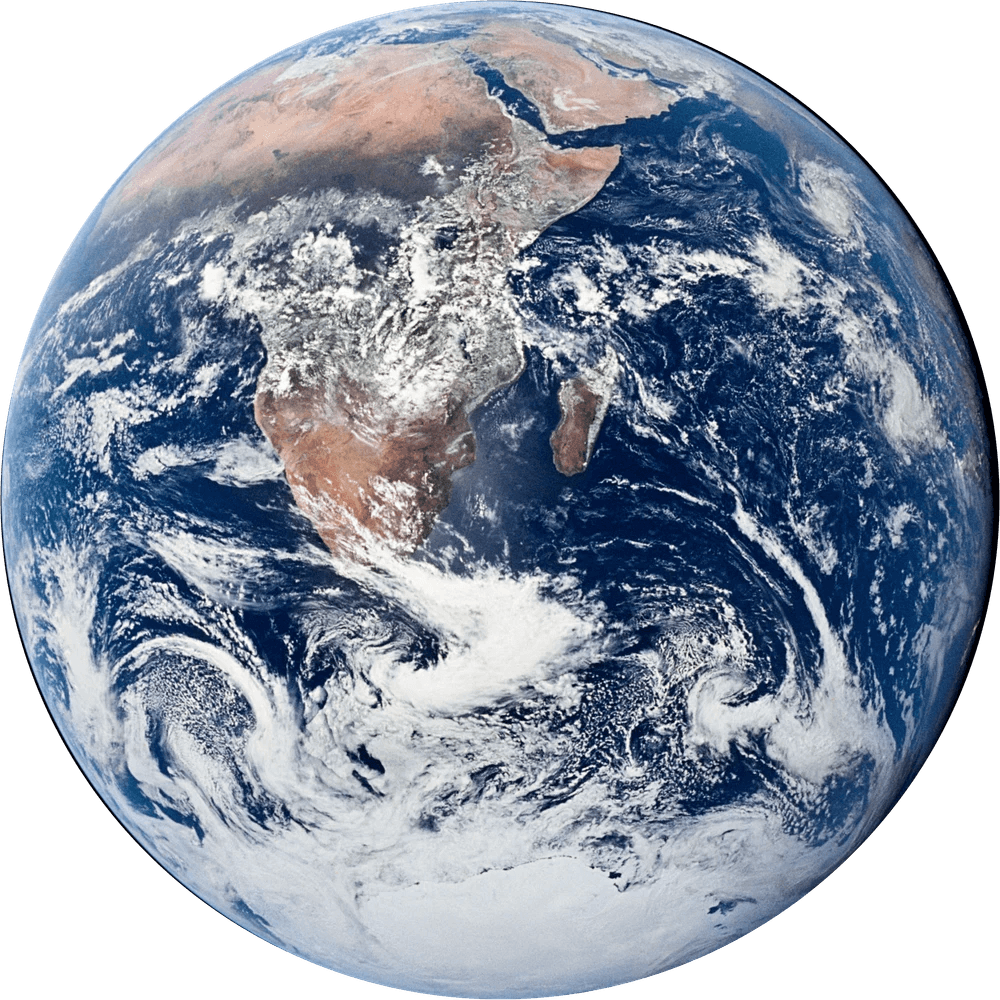
Earth
Our home planet is the third from the Sun and the largest of the four rocky planets. It is the only world known to have liquid water on its surface and the only one known to support life.
Earth in 3D
Earth lit by the Sun at this moment, with NASA’s Blue Marble by day and the city lights of NASA’s Black Marble at night. Drag to turn it. The time slider turns Earth and moves the daylight across it.
Loading 3D view...
Drag to look around, pinch or scroll to zoom.
Earth in numbers
| Diameter | 12,756 km |
|---|---|
| Distance from the Sun | 149.6 million km |
| Equatorial radius | 6,378 km |
| Polar radius | 6,357 km |
| Mass | 5.970 × 10²⁴ kg |
| Density | 5,514 kg/m³ |
| Surface gravity | 9.8 m/s² |
| Escape velocity | 11.2 km/s |
| Length of a day | 24 hours |
| Rotation period | 23.9 hours |
| Orbital period | 365.2 days |
| Closest to the Sun | 147.1 million km |
| Farthest from the Sun | 152.1 million km |
| Orbital speed | 29.8 km/s |
| Orbital inclination | 0° |
| Orbital eccentricity | 0.017 |
| Axial tilt | 23.4° |
| Mean temperature | 15 °C |
| Surface pressure | 1 bar |
| Geometric albedo | 0.434 |
| Known moons | 1 |
| Rings | No |
| Global magnetic field | Yes |
Source: NASA planetary fact sheet NASA
Earth beside the Moon and the planets
Earth drawn at the same scale as the Moon, the other planets and the Sun. Tap a world to compare it with Earth.
Tap a world to compare it with the others. Sizes are to scale, the gaps between the worlds are not.
Gravity on Earth and other worlds
Drop, jump and throw on Earth beside the Moon, the planets or the Sun. Pick a world to compare, or open the full tool. Open the gravity tool
Moon: gravity of 1.6 m/s², 0.16 times Earth’s.
Loading 3D view...
| Earth | Moon | |
|---|---|---|
| Surface gravity | 9.8 m/s² | 1.6 m/s² (0.16 ×) |
| Time to fall | 1.43 s | 3.54 s |
Moon: with a mass of 70 kg you would weigh what 11.4 kg weighs on Earth, a force of 112 newtons.
Gravity values are NASA’s, measured at the equator and including the effect of the world’s rotation. The motion is shown without air: on Earth a real ball would be slowed down a little, and in the much denser air of Venus a lot.
Frequently asked questions
Why does Earth have seasons?
Earth’s axis is tilted about 23.4° to its orbit. Through the year each hemisphere leans towards the Sun and then away from it, which changes how high the Sun climbs and how long the days are. The changing distance from the Sun plays only a small part.
How far is Earth from the Sun?
On average about 149.6 million km. The orbit is slightly oval: Earth is closest, about 147.1 million km, in early January and farthest, about 152.1 million km, in early July.
Why is a day 24 hours if Earth turns in 23.9 hours?
Earth turns once relative to the stars in about 23 hours 56 minutes. In that time it also moves along its orbit, so it has to turn a little more for the Sun to come back to the same place in the sky, which makes the 24-hour day.
Is Earth a perfect sphere?
No. Its spin makes it bulge at the equator: the equatorial radius is about 6,378 km and the polar radius about 6,357 km.
Related guides
- Moon phases explainedThe Moon is always half lit by the Sun. What changes is how much of that lit half we see from Earth.
- Twilight and dark sky: civil, nautical and astronomicalThe sky is fully dark only when the Sun is more than 18° below the horizon. Here is what happens before that.
- Aurora and the Kp index: when can you see the northern lights?The higher the Kp index, the farther from the poles the aurora reaches. Dark, clear skies and a view to the north do the rest.
- Lunar eclipses: what they are and how to watchEarth's shadow falls on the full Moon. It is safe to watch with your eyes, binoculars or a telescope.
- How to watch a solar eclipse safelyNever look at the Sun without a proper solar filter, except during totality. Here is how to watch safely.