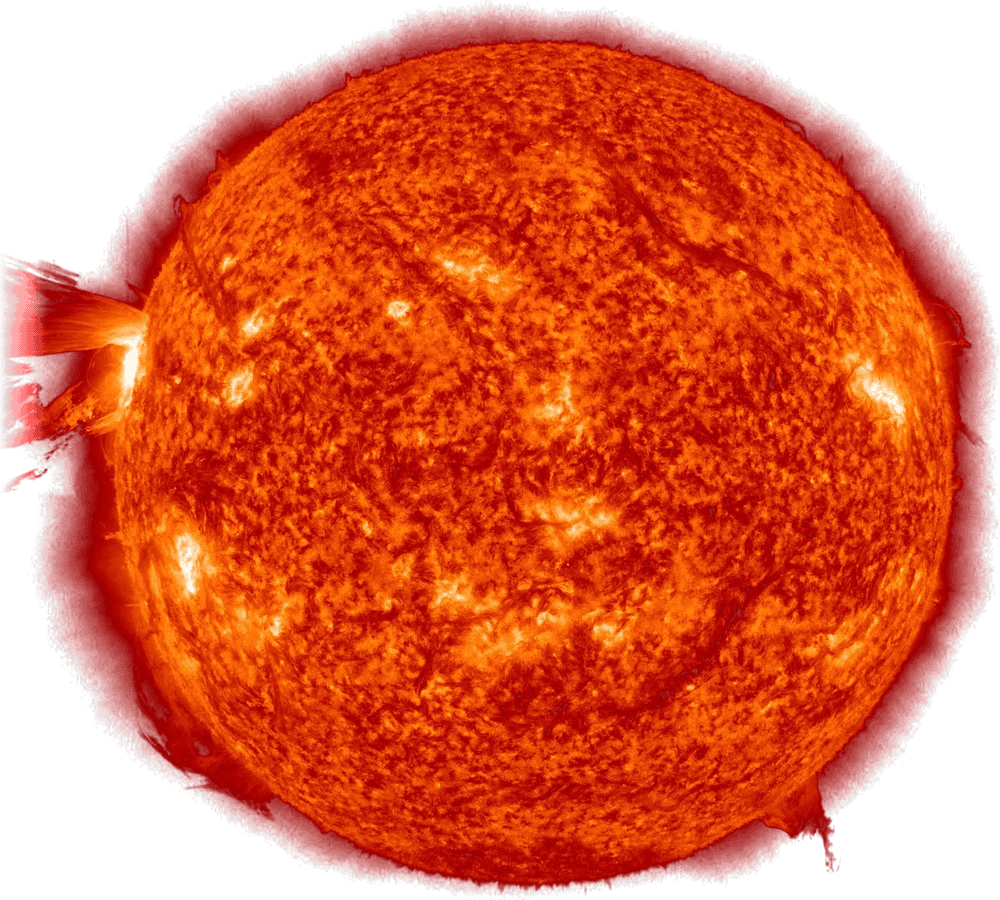
Where is the Sun now?
The Sun is the star at the centre of our solar system, a ball of hot plasma about 109 times as wide as Earth. Its light takes about 8 minutes to reach us, and its gravity holds the planets in their orbits.
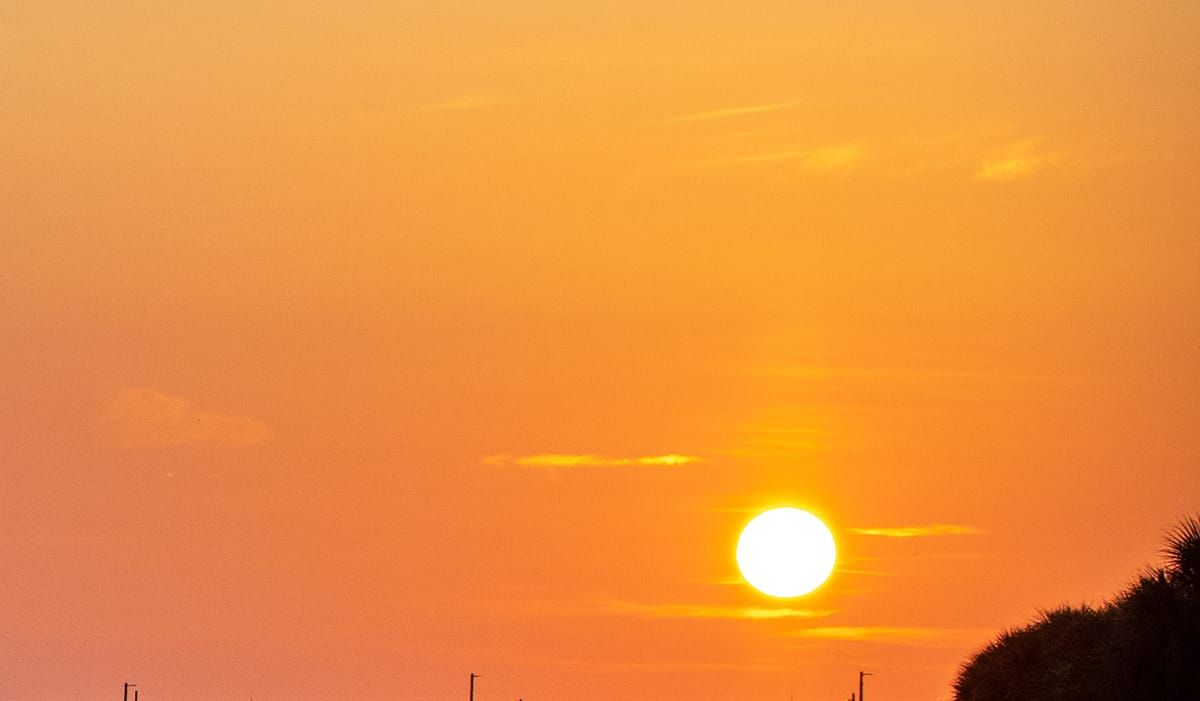
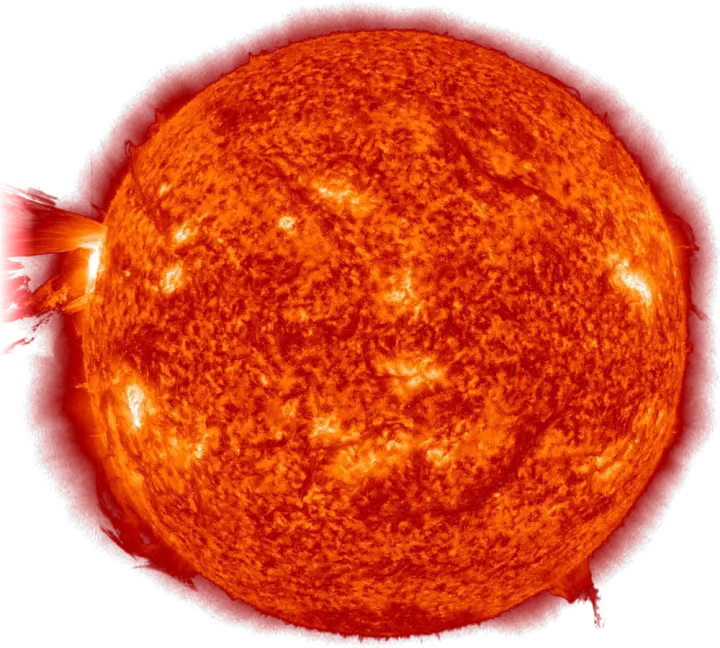
Right now
| Direction | SSE (149°) |
|---|---|
| Height above horizon | 36.4° |
| Distance from Earth | 92.7 million mi |
| Apparent size | 32.0′ |
| Constellation | Virgo |
See it on the sky
Loading 3D view...
Drag to look around, pinch or scroll to zoom.
Sun in 3D
The Sun’s visible surface with its darker edge (limb darkening), turning on its axis. Never look at the real Sun without certified eye protection.
Loading 3D view...
Drag to look around, pinch or scroll to zoom.
Ephemeris for the next 15 days
Position at 0:00 UTC each day as seen from the centre of the Earth (apparent coordinates of date), calculated with Astronomy Engine.
| Date (UTC) | Right ascension | Declination | Apparent size | Distance | Constellation |
|---|---|---|---|---|---|
| Oct 13, 2026 | 13h 12m 39s | −07° 41′ 45″ | 32.0′ | 0.9979 au | Virgo |
| Oct 14, 2026 | 13h 16m 21s | −08° 04′ 09″ | 32.0′ | 0.9977 au | Virgo |
| Oct 15, 2026 | 13h 20m 04s | −08° 26′ 26″ | 32.1′ | 0.9974 au | Virgo |
| Oct 16, 2026 | 13h 23m 47s | −08° 48′ 35″ | 32.1′ | 0.9971 au | Virgo |
| Oct 17, 2026 | 13h 27m 31s | −09° 10′ 37″ | 32.1′ | 0.9968 au | Virgo |
| Oct 18, 2026 | 13h 31m 16s | −09° 32′ 31″ | 32.1′ | 0.9965 au | Virgo |
| Oct 19, 2026 | 13h 35m 01s | −09° 54′ 17″ | 32.1′ | 0.9962 au | Virgo |
| Oct 20, 2026 | 13h 38m 46s | −10° 15′ 54″ | 32.1′ | 0.9959 au | Virgo |
| Oct 21, 2026 | 13h 42m 33s | −10° 37′ 22″ | 32.1′ | 0.9956 au | Virgo |
| Oct 22, 2026 | 13h 46m 20s | −10° 58′ 40″ | 32.1′ | 0.9954 au | Virgo |
| Oct 23, 2026 | 13h 50m 07s | −11° 19′ 49″ | 32.1′ | 0.9951 au | Virgo |
| Oct 24, 2026 | 13h 53m 55s | −11° 40′ 47″ | 32.1′ | 0.9948 au | Virgo |
| Oct 25, 2026 | 13h 57m 44s | −12° 01′ 34″ | 32.1′ | 0.9945 au | Virgo |
| Oct 26, 2026 | 14h 01m 34s | −12° 22′ 10″ | 32.2′ | 0.9943 au | Virgo |
| Oct 27, 2026 | 14h 05m 24s | −12° 42′ 35″ | 32.2′ | 0.9940 au | Virgo |
Coming up
Facts
| Diameter | 1,391,400 km |
|---|---|
| Surface gravity | 274 m/s² |
| Escape velocity | 617.6 km/s |
Source: NASA planetary fact sheet (Oct 12, 2026). Calculated with Astronomy Engine, an open-source library verified against the US Naval Observatory and NASA JPL. Data sources
Gravity compared: Sun and Earth
Drop, jump and throw on the Sun’s visible surface beside Earth or any other world. Pick a world to compare, or open the full tool. Open the gravity tool
Earth: gravity of 9.8 m/s², 0.04 times that of Sun.
Loading 3D view...
| Sun | Earth | |
|---|---|---|
| Surface gravity | 274 m/s² | 9.8 m/s² (0.04 ×) |
| Time to fall | 0.27 s | 1.43 s |
Earth: with a mass of 70 kg you would weigh what 70.0 kg weighs on Earth, a force of 686 newtons.
Gravity values are NASA’s, measured at the equator and including the effect of the world’s rotation. The motion is shown without air: on Earth a real ball would be slowed down a little, and in the much denser air of Venus a lot.
NASA news about Sun
Headlines from NASA’s news feeds (in English), updated daily. Last checked October 13, 2026.
Discoveries and exploration
Key moments in the study of Sun, each linked to its source.
- September 1, 1859R.C. Carrington and Richard Hodgson independently observe a large solar flare; its effects reach Earth the next day. Source
- May 14, 1973Skylab launches carrying the Apollo Telescope Mount, a crewed solar observatory in Earth orbit. Source
- April 17, 1976Helios 2 reaches perihelion at 0.29 AU, the closest flyby of the Sun at that time. Source
- June 26, 1994Ulysses begins observing the Sun's south polar region from above 70 degrees solar latitude. Source
- December 2, 1995The ESA-NASA Solar and Heliospheric Observatory (SOHO) launches to study the Sun from core to corona. Source
- February 11, 2010NASA's Solar Dynamics Observatory launches to study how solar activity is created and drives space weather. Source
- August 12, 2018NASA's Parker Solar Probe launches on its mission to "touch the Sun." Source
- February 10, 2020ESA's Solar Orbiter launches on its solar orbiting mission. Source
- December 14, 2021NASA announces that Parker Solar Probe has flown through the corona and sampled particles and magnetic fields there. Source
- October 15, 2024NASA, NOAA and the Solar Cycle Prediction Panel announce that the Sun has reached its solar maximum period. Source
- December 24, 2024Parker Solar Probe makes its record-breaking closest approach, about 3.8 million miles above the solar surface. Source
- June 11, 2025ESA releases Solar Orbiter's first images of the Sun's poles, taken from outside the ecliptic plane. Source
Checked against the linked NASA, ESA and NOAA pages on October 10, 2026.
How to use this page
Choose your place and a day at the top: today by default, or one of the dates under it. The tiles show when the Sun rises, is highest and sets, with its distance and apparent size. Below them you find where it is right now, the sky in 3D, the year’s events and the facts.
What the numbers mean
- Rises and sets
- When the top edge of the disc meets a flat horizon, with the bending of light by the air included, as in almanacs. A time on another day carries its date.
- Highest
- When it crosses the meridian, due south or due north, and its height above the horizon then.
- Direction and height
- The compass point and azimuth to face, counted from north through east, and the angle above the horizon. A fist at arm’s length covers about 10°.
- Distance and apparent size
- How far away it is from Earth’s centre at that moment and how wide it looks in the sky, in arcminutes (′) or arcseconds (″).
How accurate it is
Positions and times come from Astronomy Engine. In our tests positions agree with NASA JPL’s Horizons to within one arcminute, and rise and set times of the Sun and the Moon to within two minutes. Times assume a flat horizon at your place, so hills and buildings change when you actually see it rise or set. Methodology
Frequently asked questions
Why do the times change from night to night?
Earth turns once a day, and the body moves along its own path at the same time, so it rises and sets at a slightly different time each day. The Moon moves fastest and rises about 50 minutes later each day.
Do the times include hills and buildings?
No. They are for a flat horizon. Hills, trees and buildings make a body rise later and set earlier than the page shows.
Is it safe to look at the Sun?
No. Never look at the Sun directly, or through binoculars, a camera or a telescope, without a certified solar filter. Even a brief look can damage your eyes.
Related guides
- How to watch a solar eclipse safelyNever look at the Sun without a proper solar filter, except during totality. Here is how to watch safely.
- Twilight and dark sky: civil, nautical and astronomicalThe sky is fully dark only when the Sun is more than 18° below the horizon. Here is what happens before that.
- Altitude and azimuth: finding things in the skyTwo angles tell you exactly where to look: which direction, and how high.