Light pollution and dark skies: the Bortle scale
From a city centre you can count a few dozen stars. From a truly dark site you can count a few thousand, with the Milky Way bright enough to cast a shadow. The Bortle scale puts a number on the difference.
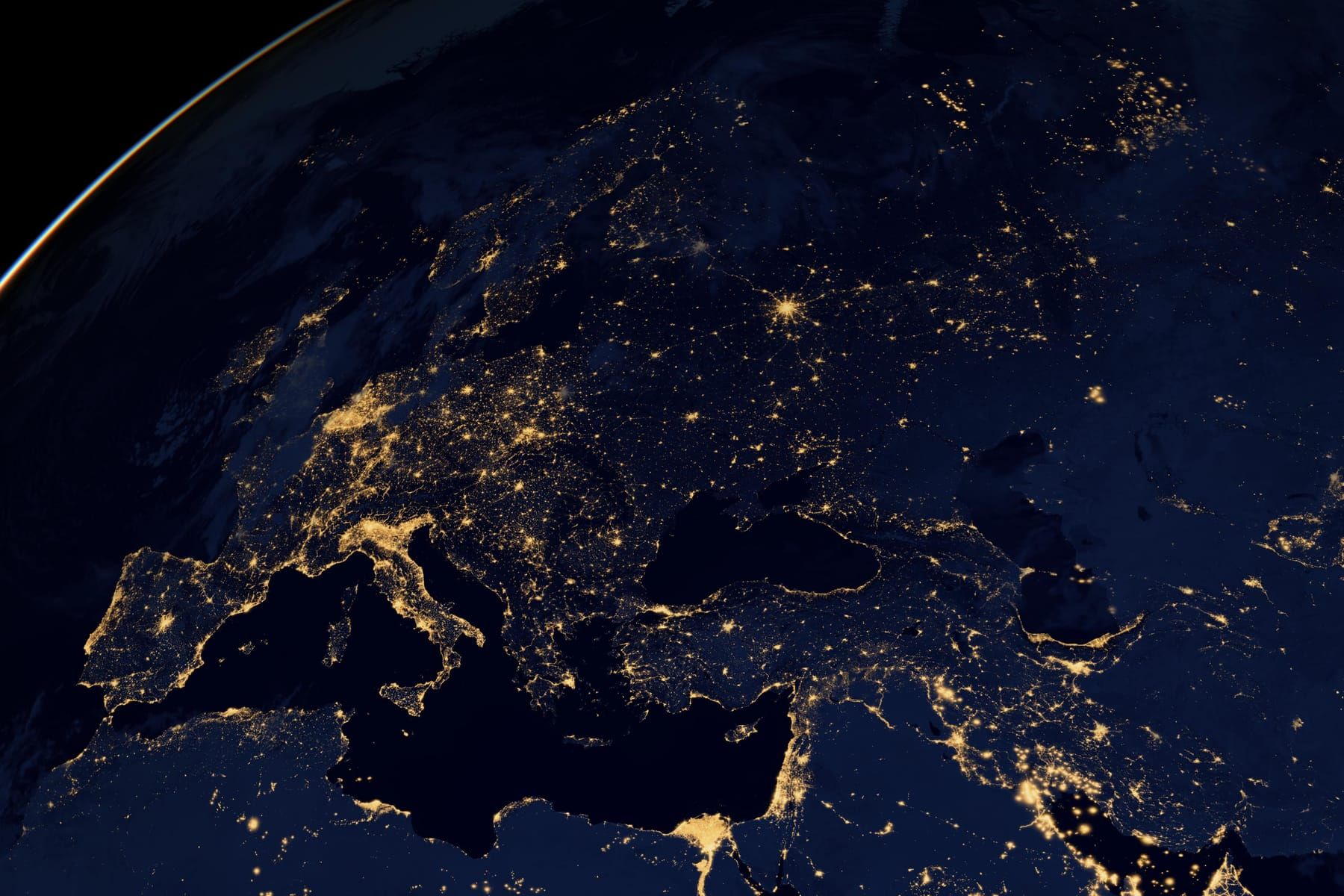
Light pollution is artificial light scattered in the atmosphere. Light that is sent upwards, or reflected from the ground, lights up the air above a town, and that glow hides faint stars the same way daylight does. It is the reason most people have never seen the Milky Way.
The Bortle scale
In 2001 the American amateur astronomer John E. Bortle published a nine-class scale in Sky & Telescope that describes sky darkness by what is visible, rather than by instruments. The naked-eye limiting magnitude (NELM) is the faintest star an experienced observer can see. See the magnitude guide for the scale.
| Class | Sky | Faintest star (NELM) | What you see |
|---|---|---|---|
| 1 | Excellent dark site | 7.6 to 8.0 | The Milky Way in Scorpius and Sagittarius casts shadows, the zodiacal light is obvious and coloured, and the Andromeda and Triangulum galaxies are visible to the naked eye |
| 2 | Truly dark site | 7.1 to 7.5 | The summer Milky Way is highly structured, with airglow visible near the horizon |
| 3 | Rural | 6.6 to 7.0 | The Milky Way still looks complex, but some light pollution shows on the horizon |
| 4 | Rural and suburban transition | 6.1 to 6.5 | The Milky Way is impressive well above the horizon but lacks detail. Light domes over towns |
| 5 | Suburban | 5.6 to 6.0 | The Milky Way is weak or invisible near the horizon and washed out overhead |
| 6 | Bright suburban | about 5.5 | The Milky Way is visible only near the zenith, and the sky within 35° of the horizon glows |
| 7 | Suburban and urban transition | about 5.0 | The Milky Way is nearly or totally invisible. The sky has a greyish white hue |
| 8 | City | 4.5 at best | The sky glows white or orange. Only the brighter constellations are recognisable |
| 9 | Inner city | 4.0 or less | Only the brightest stars remain. Many constellation figures are incomplete, and the Moon and planets are the only rewarding targets |
Most people live under class 6 to 9 skies. A class 3 or 4 sky is usually within an hour’s drive of a mid-sized city in Europe. Class 1 and 2 need remote areas, deserts, high mountains or islands.
What a darker sky gives you
- More stars. About 290 stars are brighter than magnitude 3.5, roughly what a city sky shows on a good night. Down to magnitude 6, the classic naked-eye limit, there are about 5,000 over the whole sky, half of them above your horizon at any time.
- The Milky Way. It appears from about class 5 and becomes a structured band of light from class 3.
- Colour and detail in meteor showers, comets and the aurora. Faint tails, faint meteors and faint aurora are the first things light pollution takes away.
- Deep-sky objects. Galaxies and nebulae are faint and extended. The Andromeda Galaxy is an easy naked-eye object at class 3 and only a very indistinct smudge at class 7.
Finding a dark sky
- Look at a night-lights map. Satellite images of Earth at night, such as NASA’s Black Marble, show where the glow is. Pick a site with no large town within 30 km in the direction you want to look.
- Look for designated dark-sky places. Many parks and reserves in Europe and North America are certified for their dark skies and have public viewing spots.
- Go high. Mountain sites sit above haze and often above the low glow of towns in the valleys.
- Check the Moon. A full Moon turns a class 2 site into something like class 5. The tonight page shows the Moon’s phase and when it sets.
- Let your eyes adapt. Dark adaptation takes about 20 minutes and is undone in seconds by a white light. Use a dim red light and keep phone screens dim. The site’s night-vision theme (the theme button at the top) keeps the screen red.
Light pollution and this site
The visibility of objects on Astrotempo is computed from their altitude and the Sun’s depth below the horizon, not from your local light pollution, which the site cannot know. From a city, treat faint objects (magnitude 4 and fainter) as hard, and from a class 8 or 9 sky as invisible, whatever the page says.
Sources
- John E. Bortle, “Gauging Light Pollution: The Bortle Dark-Sky Scale”, Sky & Telescope, February 2001
- NASA Earth Observatory: Black Marble (night-lights imagery)
- Star counts by magnitude: HYG Database v4.4 (see data sources)
Frequently asked questions
What is the Bortle scale?
A nine-step scale of sky darkness published by John E. Bortle in Sky & Telescope in February 2001. Class 1 is an excellent dark-sky site and class 9 an inner-city sky. Each class is defined by what you can see: the Milky Way, the zodiacal light, the faintest stars visible to the naked eye.
How far do I have to drive to find a dark sky?
It depends on the size of the city. As a rule of thumb, the glow of a large city reaches tens of kilometres and a small town's glow fades within 10 to 20 km. Look for a site with no large town in the direction you want to observe, and check the night-lights maps linked below.
Does the Moon count as light pollution?
Not in the Bortle sense, but a bright Moon washes out the sky just as badly as a suburb. For faint objects and the Milky Way, observe in the week around new Moon or after the Moon has set.