How to observe a comet
A comet rarely looks like the photos. In binoculars most comets are a soft, fuzzy patch with a hint of a tail. Only a bright one every few years shows a tail to the naked eye.
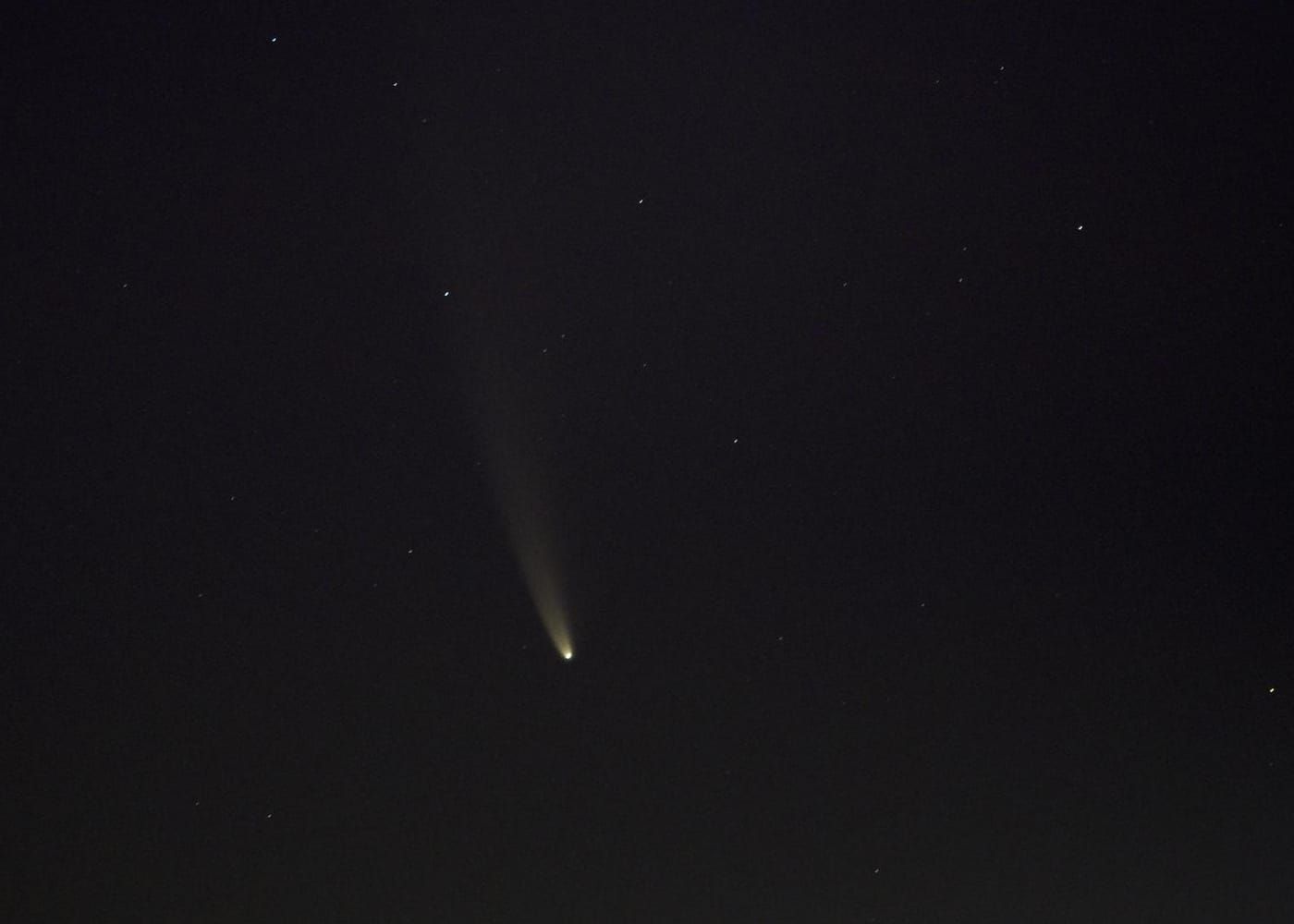
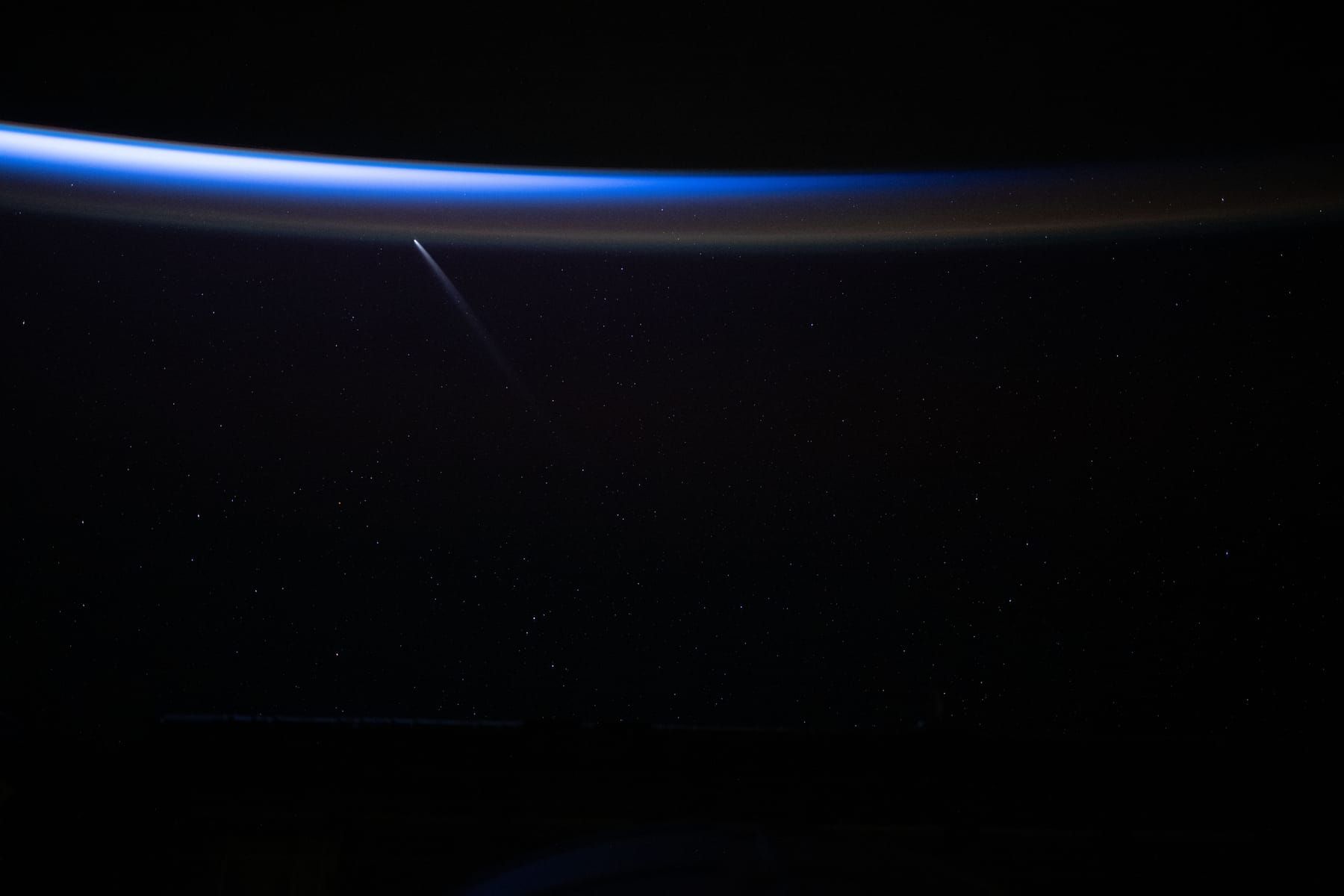
Comets are, in NASA’s words, cosmic snowballs of frozen gases, rock and dust that orbit the Sun. Far from the Sun a comet is a dark nucleus a few kilometres to a few tens of kilometres across. As it approaches the Sun it warms up, its ices turn to gas and release dust, and a glowing cloud called the coma forms around the nucleus. The coma can span hundreds of thousands of kilometres, and sunlight and the solar wind blow its gas and dust into tails that stretch away from the Sun for millions of kilometres.
The two tails
A bright comet shows two tails:
- The dust tail is broad, curved and yellowish white. It reflects sunlight and lags slightly behind the comet’s motion along its orbit.
- The ion tail (gas tail) is narrow, straight and bluish. It is pushed directly away from the Sun by the solar wind.
Both point away from the Sun, never behind the comet’s direction of travel. In binoculars you usually see only the dust tail, as a faint fan extending from the fuzzy coma.
Where comets come from
NASA explains that comets orbit in two reservoirs: the Kuiper Belt beyond Neptune, and the far more distant Oort Cloud, which reaches about 100,000 times the Earth-Sun distance. Short-period comets take less than 200 years to go round the Sun and return on a known schedule. Halley’s Comet (76 years) is the famous example. Long-period comets come from the Oort Cloud and can take thousands to millions of years per orbit, so each one we see is effectively a one-time visitor.
How bright will it be?
Comet brightness is forecast with a simple formula from two published parameters, an absolute magnitude and a rate of brightening, applied to the comet’s distances from the Sun and from Earth. The parameters are published in NASA’s Small-Body Database. These forecasts can be wrong by a magnitude or more, because the real brightness depends on how active the comet’s surface turns out to be. Two patterns to know:
- A comet brightens fastest as it nears the Sun, so the best views are often just before or after perihelion, when the comet is usually also close to the Sun in the sky, low in twilight.
- A comet’s magnitude describes its total light spread over the coma. A magnitude 5 comet is far harder to see than a magnitude 5 star, because that light is smeared over an area the size of the Moon or more. See the magnitude guide.
Finding a comet in the sky
- Check where it is tonight. A comet moves against the stars from night to night, sometimes by several degrees, so use a chart made for the date. Note which constellation it is in and how high it stands at the time you plan to look. The 3D sky shows the constellations for your location at any time.
- Choose the right time. Many bright comets are only visible low in the west after dusk or low in the east before dawn. Find a spot with a clear horizon in that direction.
- Get dark-adapted and use averted vision. Give your eyes 20 minutes without lights, then look slightly to the side of the comet’s position. The edge of the retina is more sensitive to faint light.
- Start with binoculars. Sweep the area slowly. A comet looks like a small, round, fuzzy cloud, often with a brighter centre. Once you have found it in binoculars, try the naked eye.
- Expect a fuzzy patch. The long tails in photographs are the result of long exposures. The eye sees a shorter, fainter version.
Sources
- NASA Science: Comets (what comets are, coma, tails)
- NASA Science: Comet facts (nucleus sizes, Kuiper Belt, Oort Cloud, short-period comets)
- NASA/JPL Small-Body Database (orbits and brightness parameters)
Frequently asked questions
Why does a comet's tail point away from the Sun?
Sunlight and the solar wind push the gas and dust of the coma away from the Sun. So the tail always points away from the Sun, whatever direction the comet is moving in. A comet moving away from the Sun travels tail first.
Can I see a comet with the naked eye?
Only the bright ones, roughly one every few years. Most comets that reach binocular brightness stay below naked-eye visibility. As a rule of thumb, a comet brighter than about magnitude 4 can be seen from a dark site, and one brighter than magnitude 1 even from a town.
Why are comet brightness forecasts so uncertain?
A comet's brightness depends on how much gas and dust it releases as it warms up, which varies from comet to comet and from day to day. New comets from the Oort cloud often brighten quickly at first and then stall, and some break up near the Sun.