Constellation, Serpent
Serpens
The great snake held by Ophiuchus, the only constellation split into two separate parts, the head and the tail. Its head region holds the Eagle Nebula.
From New York on October 13, 2026, the centre of Serpens rises at 9:44 AM, is highest at 4:09 PM (55° above the horizon in the S) and sets at 10:30 PM.
In the 3D sky
The sky over New York turned towards Serpens. Drag to look around.
Loading 3D view...
Drag to look around, pinch or scroll to zoom.
Evening visibility over the year
Height of the constellation’s centre above the horizon at 10 pm local time on the 15th of each month, from New York. Above about 30° it is well placed.
Name and history
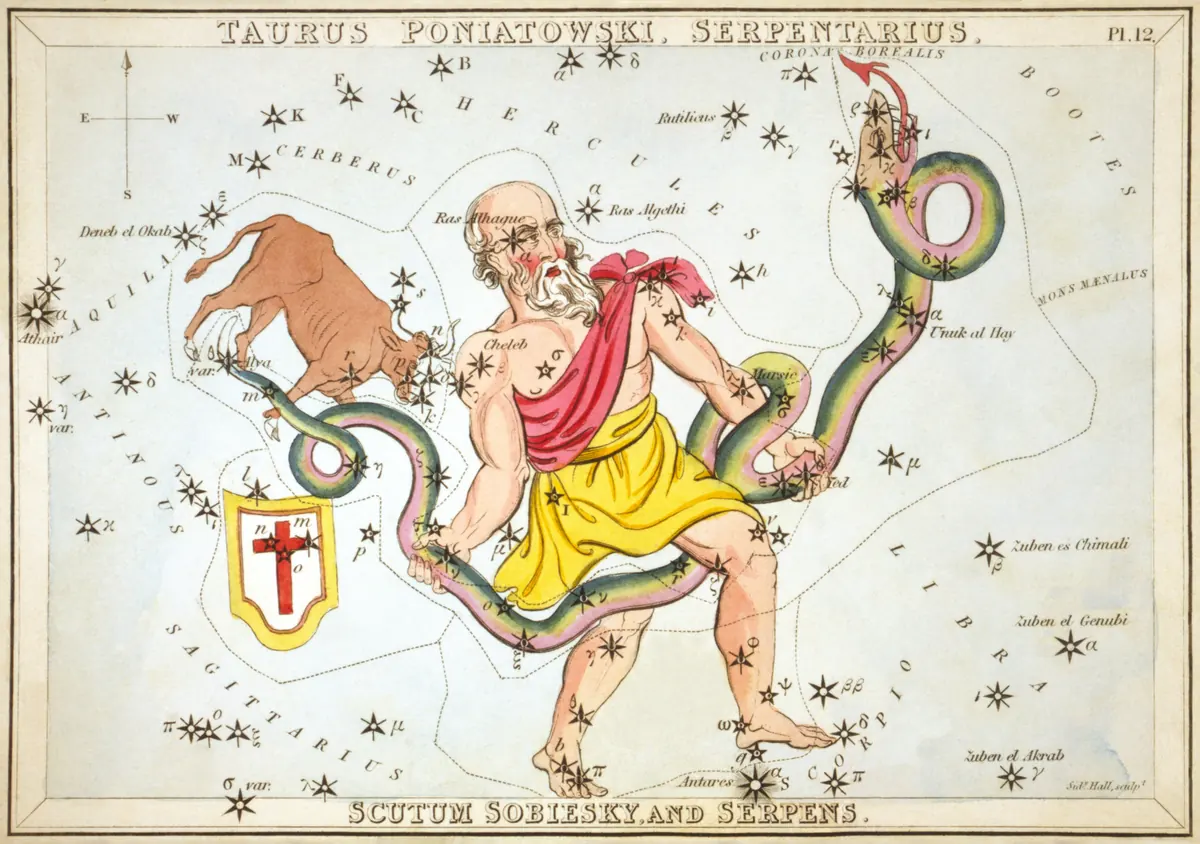
Serpens is the snake gripped by Ophiuchus, who was identified with the healer Asclepius. In the story, Asclepius saw one snake bring another back to life with a herb, and he used the same herb to revive the dead. Snakes became a sign of rebirth because they shed their skins. The real Aesculapian snake of Greece and Italy is harmless and was used in healing rituals in ancient temples of Asclepius. That is presumably the kind of snake he holds, although much larger in the sky. The Greeks called the figure Ophis. Ptolemy listed it as ‘the serpent of the serpent holder’, perhaps to avoid confusion with Draco and Hydra.
Mapmakers usually drew the man and the snake as one combined figure. When Eugène Delporte drew the official boundaries in the late 1920s, he followed an idea of Benjamin Gould and cut the snake in two. Serpens Caput, the head, lies on one side of Ophiuchus and Serpens Cauda, the tail, on the other. The brightest star, Unukalhai, comes from Arabic for ‘the serpent’s neck’. The Eagle Nebula, famous from a Hubble photograph of gas pillars, lies in Serpens.
Sources: Ian Ridpath, Star Tales: Serpens
Brightest stars
| Star | Designation | Magnitude | Distance |
|---|---|---|---|
| Unukalhai | α Ser | 2.63 | 74 light-years |
| η Ser | η Ser | 3.23 | 61 light-years |
| μ Ser | μ Ser | 3.54 | 170 light-years |
| ξ Ser | ξ Ser | 3.54 | 105 light-years |
| Zhou | β Ser | 3.65 | 155 light-years |
| ε Ser | ε Ser | 3.71 | 70 light-years |
| δ Ser | δ Ser | 3.80 | 228 light-years |
| γ Ser | γ Ser | 3.85 | 37 light-years |
| Gudja | κ Ser | 4.09 | 382 light-years |
| ο Ser | ο Ser | 4.24 | 173 light-years |
Facts
| Area | about 632 square degrees (23 of 88) |
|---|---|
| IAU abbreviation | Ser |
| Sky | Near the celestial equator, visible from both hemispheres |
| Origin | Listed in Ptolemy’s Almagest, about AD 150, as Ophis Ophiouchou, the serpent of the serpent holder |
| Stars brighter than magnitude 5 | 19 |
| Centre (J2000) | 16.7 h, 6° |
Deep-sky objects
Galaxies, clusters and nebulae brighter than magnitude 9, from the OpenNGC catalogue. Most need binoculars or a telescope and a dark sky.
Boundaries: International Astronomical Union, via Astronomy Engine. Areas are computed from the boundaries by sampling (within about one percent). Names and lines: Stellarium. Stars: HYG Database. Deep-sky objects: OpenNGC. Calculated with Astronomy Engine, an open-source library verified against the US Naval Observatory and NASA JPL. Data sources
How to use this page
Choose your place and a night at the top. The answer and the 3D view show where the constellation is, when it is highest and whether it rises at all from where you are. The chart shows its stars and lines, and the tables list its brightest stars and the deep-sky objects inside it.
Frequently asked questions
When is a constellation best seen?
When it is highest in a dark sky, which the page gives for the night you pick. Each constellation is best placed in a particular season, because the stars rise about four minutes earlier every night.
Why can I not see a constellation from my place?
Constellations far south of the celestial equator never rise from northern places, and those far north never rise from southern ones. The page says when this is the case.
What are the constellation boundaries?
The International Astronomical Union divides the sky into 88 areas with official boundaries. The stick figures are only a drawing aid, the boundaries say which constellation a point in the sky belongs to.
Related guides
- How to learn the constellationsStart with one bright pattern you cannot miss, use it as a signpost to its neighbours, and come back a month later: the sky will have turned, and you will know a little more of it.
- Altitude and azimuth: finding things in the skyTwo angles tell you exactly where to look: which direction, and how high.
- Light pollution and dark skies: the Bortle scaleFrom a city centre you can count a few dozen stars. From a truly dark site you can count a few thousand, with the Milky Way bright enough to cast a shadow. The Bortle scale puts a number on the difference.
- Binoculars for stargazing: what to buy and what to look atA pair of 7x50 or 10x50 binoculars shows the craters of the Moon, the moons of Jupiter, dozens of star clusters and the Andromeda Galaxy, for a fraction of the cost of a telescope.