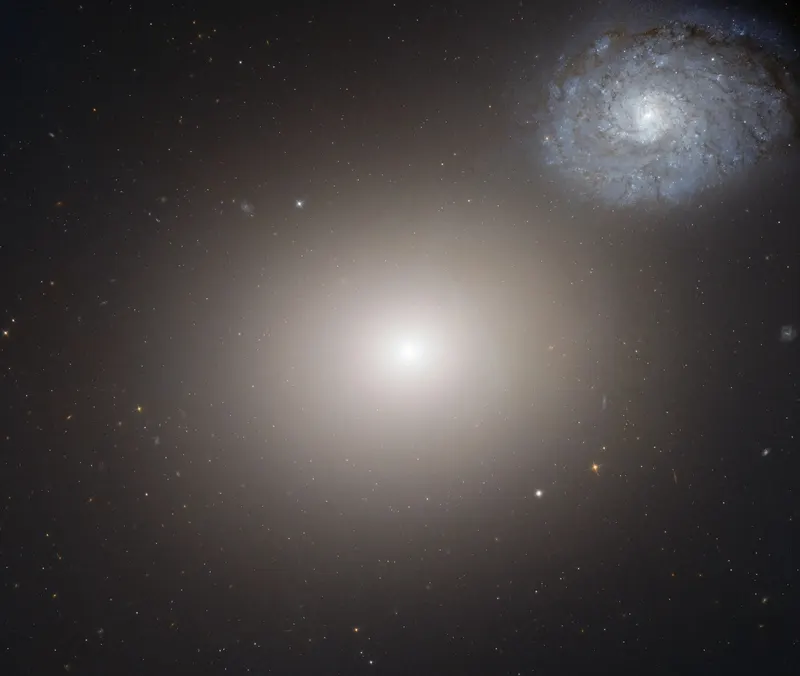
Galaxy in Virgo
M60 (NGC 4649)
Photo: NASA, ESA and the Hubble Heritage (STScI/AURA)-ESA/Hubble CollaborationFrom New York on October 13, 2026, M60 rises at 5:26 AM in the ENE, is highest at 12:12 PM (61° above the horizon in the S) and sets at 6:54 PM in the WNW.
In the 3D sky
The sky over New York turned towards M60. Drag to look around.
Loading 3D view...
Drag to look around, pinch or scroll to zoom.
Evening visibility over the year
Height of M60 above the horizon at 10 pm local time on the 15th of each month, from New York.
Facts
| Type | Galaxy (E) |
|---|---|
| Brightness (magnitude) | 8.8 |
| Size in the sky | 6.8 × 5.5 arcminutes |
| Constellation | Virgo |
| Position (J2000) | 12h 43m 40s, +11° 33′ 10″ |
| Other designations | NGC 4649 |
Hubble’s view
Finder charts
A wide field to find the right part of the sky and a closer field with fainter stars. North is up and east on the left.
Nearby Messier objects
- M59 (NGC 4621)Galaxy · 0.4° away
- M58 (NGC 4579)Galaxy · 1.5° away
- M89 (NGC 4552)Galaxy · 2.2° away
- M90 (NGC 4569)Galaxy · 2.3° away
- M87 (Virgo A)Galaxy · 3.3° away
- M91 (NGC 4548)Galaxy · 3.6° away
Data: OpenNGC (CC BY-SA 4.0). Photo: NASA Hubble Messier Catalog, credit as shown. Data sources
How to use this page
Choose your place and a night at the top. The page shows when the object is highest and where to look, the 3D sky with it marked, and its visibility through the year. The finder charts help you star-hop to it with binoculars or a small telescope.
Frequently asked questions
Can I see it with the naked eye?
The brightest Messier objects, such as the Pleiades and the Orion Nebula, show to the eye under a dark sky. Most others need binoculars or a small telescope, and all of them look best far from city lights.
Why does it look grey and not colourful like the photo?
The eye’s colour cells do not work in dim light, so faint objects look grey. Photos collect light for minutes or hours and show colours the eye cannot see.
When is the best time to look?
When the object is high in a dark sky and the Moon is down or a thin crescent. The page gives the best time for the night you choose.
Related guides
- Binoculars for stargazing: what to buy and what to look atA pair of 7x50 or 10x50 binoculars shows the craters of the Moon, the moons of Jupiter, dozens of star clusters and the Andromeda Galaxy, for a fraction of the cost of a telescope.
- Light pollution and dark skies: the Bortle scaleFrom a city centre you can count a few dozen stars. From a truly dark site you can count a few thousand, with the Milky Way bright enough to cast a shadow. The Bortle scale puts a number on the difference.
- Magnitude: how star brightness is measuredLower numbers mean brighter, and five magnitudes are a factor of 100 in brightness.