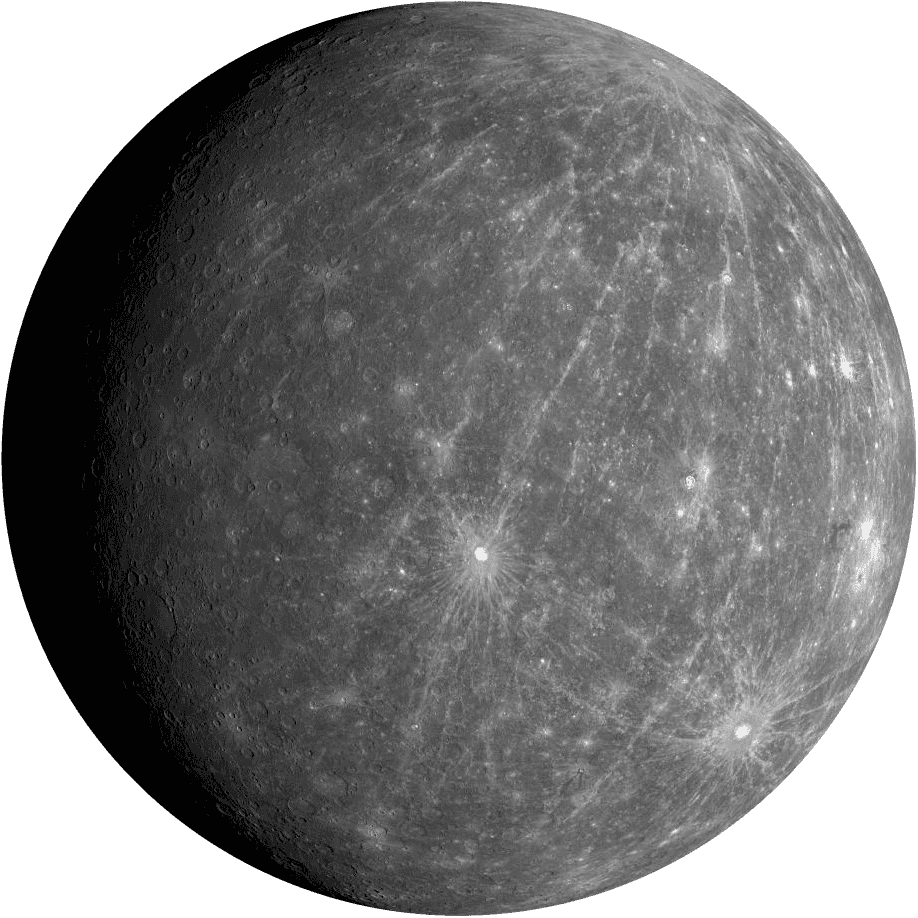
Where is Mercury tonight?
Mercury is the smallest planet and the closest to the Sun, only a little larger than our Moon. It circles the Sun every 88 days and never strays far from it in our sky, so it is seen low in twilight after sunset or before sunrise.
Right now
| Direction | SSE (147°) |
|---|---|
| Height above horizon | 23.0° |
| Distance from Earth | 91.2 million mi |
| Distance from the Sun | 40.0 million mi |
| Apparent size | 6.9″ |
| Illuminated | 59% |
| Brightness (magnitude) | -0.1 |
| Constellation | Libra |
See it on the sky
Loading 3D view...
Drag to look around, pinch or scroll to zoom.
Mercury in 3D
Mercury lit by the Sun at this moment and seen from Earth’s direction, so its phase matches what a telescope shows. Drag to turn it. The time slider moves the light and the rotation.
Loading 3D view...
Drag to look around, pinch or scroll to zoom.
Where to find Mercury among the stars
Two finder charts for today: a wide field to find the right part of the sky and a closer field with fainter stars. North is up and east on the left, as the sky looks to the naked eye. The dotted line marks its path over the coming weeks, one dot per week.
Stars: HYG Database. Constellation figures: Stellarium. Deep-sky objects: OpenNGC (Messier objects marked M).
Visibility over the next 12 months
Angle between Mercury and the Sun on the 15th of each month. The further from the Sun, the darker the sky around it. Colour shows whether it is in the evening or the morning sky.
Evening sky Morning sky
Ephemeris for the next 15 days
Position at 0:00 UTC each day as seen from the centre of the Earth (apparent coordinates of date), calculated with Astronomy Engine.
| Date (UTC) | Right ascension | Declination | Magnitude | Apparent size | Distance | From the Sun | Constellation |
|---|---|---|---|---|---|---|---|
| Oct 13, 2026 | 14h 45m 09s | −19° 02′ 43″ | -0.08 | 6.8″ | 0.9927 au | 25.2° | Libra |
| Oct 14, 2026 | 14h 48m 50s | −19° 23′ 02″ | -0.07 | 6.9″ | 0.9751 au | 25.1° | Libra |
| Oct 15, 2026 | 14h 52m 19s | −19° 41′ 44″ | -0.06 | 7.0″ | 0.9572 au | 25.0° | Libra |
| Oct 16, 2026 | 14h 55m 35s | −19° 58′ 44″ | -0.05 | 7.2″ | 0.9390 au | 24.8° | Libra |
| Oct 17, 2026 | 14h 58m 38s | −20° 13′ 53″ | -0.03 | 7.3″ | 0.9207 au | 24.6° | Libra |
| Oct 18, 2026 | 15h 01m 24s | −20° 27′ 04″ | 0.00 | 7.5″ | 0.9021 au | 24.3° | Libra |
| Oct 19, 2026 | 15h 03m 53s | −20° 38′ 08″ | 0.04 | 7.6″ | 0.8834 au | 23.9° | Libra |
| Oct 20, 2026 | 15h 06m 03s | −20° 46′ 54″ | 0.09 | 7.8″ | 0.8647 au | 23.5° | Libra |
| Oct 21, 2026 | 15h 07m 51s | −20° 53′ 12″ | 0.15 | 8.0″ | 0.8459 au | 22.9° | Libra |
| Oct 22, 2026 | 15h 09m 16s | −20° 56′ 50″ | 0.23 | 8.1″ | 0.8273 au | 22.3° | Libra |
| Oct 23, 2026 | 15h 10m 14s | −20° 57′ 35″ | 0.34 | 8.3″ | 0.8089 au | 21.5° | Libra |
| Oct 24, 2026 | 15h 10m 45s | −20° 55′ 12″ | 0.46 | 8.5″ | 0.7908 au | 20.6° | Libra |
| Oct 25, 2026 | 15h 10m 44s | −20° 49′ 27″ | 0.63 | 8.7″ | 0.7732 au | 19.6° | Libra |
| Oct 26, 2026 | 15h 10m 12s | −20° 40′ 06″ | 0.83 | 8.9″ | 0.7563 au | 18.4° | Libra |
| Oct 27, 2026 | 15h 09m 05s | −20° 26′ 52″ | 1.07 | 9.1″ | 0.7403 au | 17.1° | Libra |
Distance from Earth
Distance from Earth over the past and the coming year. The closest approach in this period: June 21, 2027, 83.0 million km.
Million kilometres, sampled every three days.
Brightness
Visual magnitude over the same two years. Higher on the chart is brighter.
Coming up
Facts
| Diameter | 4,879 km |
|---|---|
| Equatorial radius | 2,441 km |
| Polar radius | 2,438 km |
| Mass | 0.330 × 10²⁴ kg |
| Density | 5,429 kg/m³ |
| Surface gravity | 3.7 m/s² |
| Escape velocity | 4.3 km/s |
| Length of a day | 4,223 hours |
| Rotation period | 1,408 hours |
| Orbital period | 88 days |
| Closest to the Sun | 46 million km |
| Farthest from the Sun | 69.8 million km |
| Orbital speed | 47.4 km/s |
| Orbital inclination | 7° |
| Orbital eccentricity | 0.206 |
| Axial tilt | 0.0° |
| Mean temperature | 167 °C |
| Surface pressure | 0 |
| Geometric albedo | 0.142 |
| Known moons | 0 |
| Rings | No |
| Global magnetic field | Yes |
Moon count: NASA, page updated April 25, 2025
Source: NASA planetary fact sheet (Oct 12, 2026). Calculated with Astronomy Engine, an open-source library verified against the US Naval Observatory and NASA JPL. Data sources
Gravity compared: Mercury and Earth
Drop, jump and throw side by side: Mercury on one side, Earth or any other world on the other. Pick a world to compare, or open the full tool. Open the gravity tool
Earth: gravity of 9.8 m/s², 2.65 times that of Mercury.
Loading 3D view...
| Mercury | Earth | |
|---|---|---|
| Surface gravity | 3.7 m/s² | 9.8 m/s² (2.65 ×) |
| Time to fall | 2.32 s | 1.43 s |
Earth: with a mass of 70 kg you would weigh what 70.0 kg weighs on Earth, a force of 686 newtons.
Gravity values are NASA’s, measured at the equator and including the effect of the world’s rotation. The motion is shown without air: on Earth a real ball would be slowed down a little, and in the much denser air of Venus a lot.
Latest NASA images of Mercury
The newest images about it in NASA’s Photojournal, updated daily. Open one for NASA’s full caption and the original file.
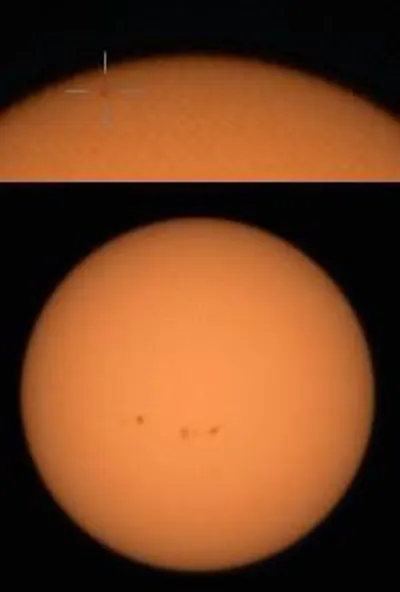
Perseverance Views a Transit of Mercury · Mar 5, 2024 · PIA26250 · Photo: NASA/JPL-Caltech/ASU/MSSS/SSI 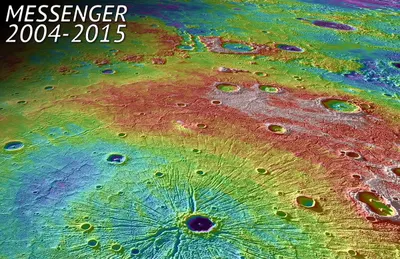
In Tribute · May 1, 2015 · PIA19450 · Photo: NASA/Johns Hopkins University Applied Physics Laboratory/Carnegie Institution of Washington 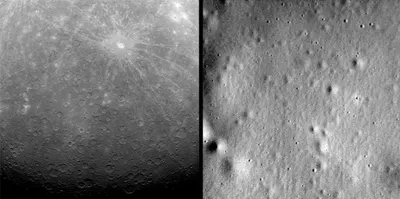
From the First to the Last · Apr 30, 2015 · PIA19449 · Photo: NASA/Johns Hopkins University Applied Physics Laboratory/Carnegie Institution of Washington 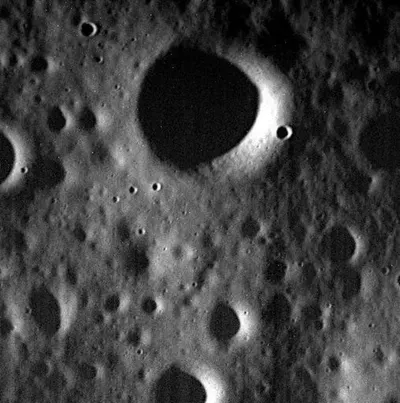
One of the Last · Apr 30, 2015 · PIA19445 · Photo: NASA/Johns Hopkins University Applied Physics Laboratory/Carnegie Institution of Washington 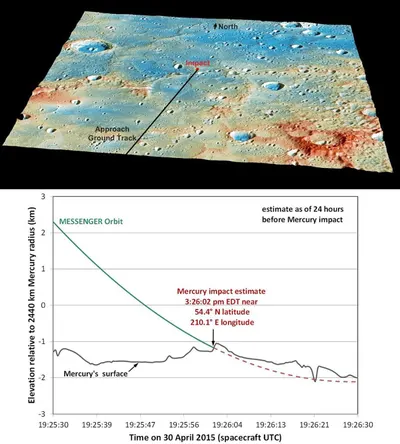
Details of MESSENGER’s Impact Location · Apr 29, 2015 · PIA19443 · Photo: NASA/Johns Hopkins University Applied Physics Laboratory/Carnegie Institution of Washington 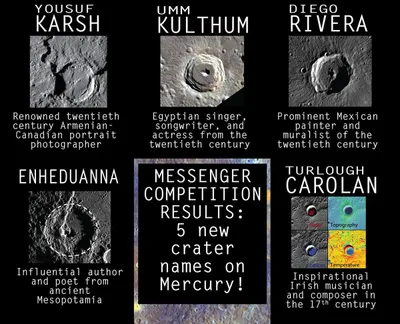
Five New Crater Names for Mercury · Apr 29, 2015 · PIA19439 · Photo: NASA/Johns Hopkins University Applied Physics Laboratory/Carnegie Institution of Washington
NASA news about Mercury
- A Closer Look at Mercury’s Spin and Gravity Reveals the Planet’s Inner Solid Core
- 45 Years Ago: Mariner 10 First to Explore Mercury
- What Scientists Found After Sifting Through Dust in the Solar System
- NASA Team Studies Middle-aged Sun by Tracking Motion of Mercury
- Small Collisions Make Big Impact on Mercury’s Thin Atmosphere
- NASA Television to Air Service Honoring Legacy of John Glenn
Headlines from NASA’s news feeds (in English), updated daily. Last checked October 13, 2026.
Discoveries and exploration
Key moments in the study of Mercury, each linked to its source.
- March 29, 1974Mariner 10, the first spacecraft sent to Mercury, makes its first flyby at a range of 703 km. Source
- March 16, 1975Mariner 10's third and closest flyby passes about 327 km from Mercury. Source
- 1991The Arecibo radio telescope detects radar-bright patches at Mercury's poles, consistent with water ice. Source
- January 14, 2008NASA's MESSENGER makes the first of its three Mercury flybys. Source
- March 18, 2011MESSENGER enters orbit, becoming the first spacecraft to orbit Mercury. Source
- November 29, 2012MESSENGER results give compelling support for abundant water ice in Mercury's permanently shadowed polar craters. Source
- April 30, 2015Out of propellant, MESSENGER ends its mission by impacting Mercury's surface, creating a new crater. Source
- October 20, 2018ESA and JAXA launch BepiColombo, two orbiters travelling together to Mercury. Source
- October 1, 2021BepiColombo makes its first Mercury flyby and sends back images. Source · Recent NASA photos
- January 8, 2025BepiColombo makes its sixth and final Mercury flyby, passing 295 km above the surface. Source
Checked against the linked NASA, ESA and NOAA pages on October 10, 2026.
How to use this page
Choose your place and a night at the top: tonight by default, or one of the dates under it. The tiles show when Mercury rises, is highest and sets, and the numbers that matter for that night. Below them you find where it is right now, the sky in 3D with Mercury marked, finder charts, the year ahead and the facts.
What the numbers mean
- Rises and sets
- When the top edge of the disc meets a flat horizon, with the bending of light by the air included, as in almanacs. A time on another day carries its date.
- Highest
- When it crosses the meridian, due south or due north, and its height above the horizon then.
- Direction and height
- The compass point and azimuth to face, counted from north through east, and the angle above the horizon. A fist at arm’s length covers about 10°.
- Distance and apparent size
- How far away it is from Earth’s centre at that moment and how wide it looks in the sky, in arcminutes (′) or arcseconds (″).
- Magnitude
- Brightness: the smaller the number, the brighter. About 6 is the faintest the eye sees under a dark sky.
How accurate it is
Positions and times come from Astronomy Engine. In our tests positions agree with NASA JPL’s Horizons to within one arcminute, and rise and set times of the Sun and the Moon to within two minutes. Times assume a flat horizon at your place, so hills and buildings change when you actually see it rise or set. Methodology
Frequently asked questions
Why do the times change from night to night?
Earth turns once a day, and the body moves along its own path at the same time, so it rises and sets at a slightly different time each day. The Moon moves fastest and rises about 50 minutes later each day.
Why does a time show another date?
The page follows the night that starts on the evening of the chosen date. A rise, highest point or set after midnight belongs to the next date, so it carries that date.
Do the times include hills and buildings?
No. They are for a flat horizon. Hills, trees and buildings make a body rise later and set earlier than the page shows.
How do I find it in the sky?
Use the direction and height at its best time, then the finder charts further down to place it among the stars. The 3D sky shows it from your place at any time of the night.
Related guides
- How to find planets in the night skyFive planets are easy to see with the naked eye. Here is where to look, when, and how to recognise them.
- Opposition, conjunction and elongation explainedThree words from the planet calendar, and what they mean for when you can see each planet.
- Magnitude: how star brightness is measuredLower numbers mean brighter, and five magnitudes are a factor of 100 in brightness.
- Altitude and azimuth: finding things in the skyTwo angles tell you exactly where to look: which direction, and how high.
- Binoculars for stargazing: what to buy and what to look atA pair of 7x50 or 10x50 binoculars shows the craters of the Moon, the moons of Jupiter, dozens of star clusters and the Andromeda Galaxy, for a fraction of the cost of a telescope.