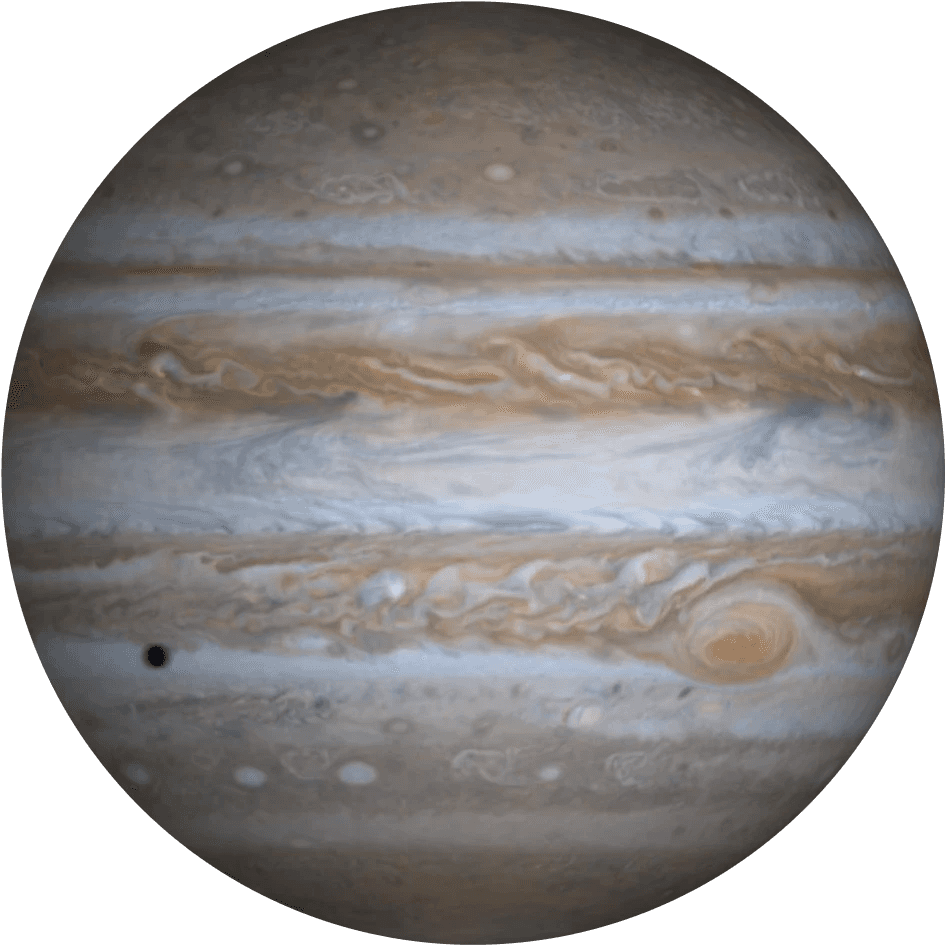
Where is Jupiter tonight?
Jupiter is the largest planet, more than twice as massive as all the other planets together. It is a gas giant of hydrogen and helium with coloured cloud bands and the Great Red Spot, a storm larger than Earth. Binoculars show its four large moons.
Right now
| Direction | SW (234°) |
|---|---|
| Height above horizon | 53.4° |
| Distance from Earth | 535.7 million mi |
| Distance from the Sun | 493.7 million mi |
| Apparent size | 34.2″ |
| Illuminated | 99% |
| Brightness (magnitude) | -1.9 |
| Constellation | Leo |
See it on the sky
Loading 3D view...
Drag to look around, pinch or scroll to zoom.
Jupiter in 3D
Jupiter lit by the Sun at this moment and seen from Earth’s direction, so its phase matches what a telescope shows. Drag to turn it. The time slider moves the light and the rotation.
Loading 3D view...
Drag to look around, pinch or scroll to zoom.
Jupiter’s moons and the Great Red Spot Where the four large moons and their shadows are, this week’s transits and eclipses, and when the Great Red Spot faces Earth.
Where to find Jupiter among the stars
Two finder charts for today: a wide field to find the right part of the sky and a closer field with fainter stars. North is up and east on the left, as the sky looks to the naked eye. The dotted line marks its path over the coming weeks, one dot per week.
Stars: HYG Database. Constellation figures: Stellarium. Deep-sky objects: OpenNGC (Messier objects marked M).
Jupiter’s moons right now
Io, Europa, Ganymede and Callisto beside the planet as seen from Earth in binoculars or a small telescope: east on the left, as with the naked eye (a telescope may flip the view). Drag the slider through the coming day.
- Io: in Jupiter’s shadow (eclipse)
- Europa: west of Jupiter, 8.4 Jupiter radii from the centre
- Ganymede: east of Jupiter, 2.4 Jupiter radii from the centre
- Callisto: in Jupiter’s shadow (eclipse)
Positions from Astronomy Engine’s model of the Galilean moons. A moon in transit is drawn as an open circle. Eclipsed or occulted moons are not drawn.
Visibility over the next 12 months
Angle between Jupiter and the Sun on the 15th of each month. The further from the Sun, the darker the sky around it. Colour shows whether it is in the evening or the morning sky.
Evening sky Morning sky
Ephemeris for the next 15 days
Position at 0:00 UTC each day as seen from the centre of the Earth (apparent coordinates of date), calculated with Astronomy Engine.
| Date (UTC) | Right ascension | Declination | Magnitude | Apparent size | Distance | From the Sun | Constellation |
|---|---|---|---|---|---|---|---|
| Oct 13, 2026 | 09h 36m 52s | +14° 53′ 25″ | -1.92 | 34.2″ | 5.7716 au | 58.0° | Leo |
| Oct 14, 2026 | 09h 37m 29s | +14° 50′ 30″ | -1.93 | 34.2″ | 5.7582 au | 58.9° | Leo |
| Oct 15, 2026 | 09h 38m 07s | +14° 47′ 36″ | -1.93 | 34.3″ | 5.7448 au | 59.7° | Leo |
| Oct 16, 2026 | 09h 38m 43s | +14° 44′ 45″ | -1.94 | 34.4″ | 5.7312 au | 60.5° | Leo |
| Oct 17, 2026 | 09h 39m 20s | +14° 41′ 55″ | -1.94 | 34.5″ | 5.7175 au | 61.4° | Leo |
| Oct 18, 2026 | 09h 39m 56s | +14° 39′ 07″ | -1.95 | 34.6″ | 5.7037 au | 62.2° | Leo |
| Oct 19, 2026 | 09h 40m 31s | +14° 36′ 21″ | -1.95 | 34.6″ | 5.6898 au | 63.1° | Leo |
| Oct 20, 2026 | 09h 41m 06s | +14° 33′ 38″ | -1.95 | 34.7″ | 5.6757 au | 63.9° | Leo |
| Oct 21, 2026 | 09h 41m 40s | +14° 30′ 56″ | -1.96 | 34.8″ | 5.6616 au | 64.8° | Leo |
| Oct 22, 2026 | 09h 42m 14s | +14° 28′ 17″ | -1.96 | 34.9″ | 5.6474 au | 65.6° | Leo |
| Oct 23, 2026 | 09h 42m 48s | +14° 25′ 40″ | -1.97 | 35.0″ | 5.6331 au | 66.5° | Leo |
| Oct 24, 2026 | 09h 43m 21s | +14° 23′ 05″ | -1.98 | 35.1″ | 5.6186 au | 67.3° | Leo |
| Oct 25, 2026 | 09h 43m 54s | +14° 20′ 32″ | -1.98 | 35.2″ | 5.6041 au | 68.2° | Leo |
| Oct 26, 2026 | 09h 44m 26s | +14° 18′ 01″ | -1.99 | 35.3″ | 5.5895 au | 69.0° | Leo |
| Oct 27, 2026 | 09h 44m 57s | +14° 15′ 33″ | -1.99 | 35.4″ | 5.5749 au | 69.9° | Leo |
Distance from Earth
Distance from Earth over the past and the coming year. The closest approach in this period: January 9, 2026, 633.1 million km.
Million kilometres, sampled every three days.
Brightness
Visual magnitude over the same two years. Higher on the chart is brighter.
Coming up
- Moon near Jupiter
- Conjunction of Mars and Jupiter
- Moon near Jupiter
- Moon near Jupiter
- Moon near Jupiter
- Jupiter at opposition
- Moon near Jupiter
- Moon near Jupiter
Facts
| Diameter | 142,984 km |
|---|---|
| Equatorial radius | 71,492 km |
| Polar radius | 66,854 km |
| Mass | 1,898 × 10²⁴ kg |
| Density | 1,326 kg/m³ |
| Surface gravity | 23.1 m/s² |
| Escape velocity | 59.5 km/s |
| Length of a day | 9.9 hours |
| Rotation period | 9.9 hours |
| Orbital period | 4,331 days |
| Closest to the Sun | 740.6 million km |
| Farthest from the Sun | 816.4 million km |
| Orbital speed | 13.1 km/s |
| Orbital inclination | 1.3° |
| Orbital eccentricity | 0.049 |
| Axial tilt | 3.1° |
| Mean temperature | -110 °C |
| Geometric albedo | 0.538 |
| Known moons | 115 |
| Rings | Yes |
| Global magnetic field | Yes |
Moon count: NASA, page updated September 21, 2026
Source: NASA planetary fact sheet (Oct 12, 2026). Calculated with Astronomy Engine, an open-source library verified against the US Naval Observatory and NASA JPL. Data sources
Gravity compared: Jupiter and Earth
Drop, jump and throw side by side: Jupiter on one side, Earth or any other world on the other. Pick a world to compare, or open the full tool. Open the gravity tool
Earth: gravity of 9.8 m/s², 0.42 times that of Jupiter.
Loading 3D view...
| Jupiter | Earth | |
|---|---|---|
| Surface gravity | 23.1 m/s² | 9.8 m/s² (0.42 ×) |
| Time to fall | 0.93 s | 1.43 s |
Earth: with a mass of 70 kg you would weigh what 70.0 kg weighs on Earth, a force of 686 newtons.
Gravity values are NASA’s, measured at the equator and including the effect of the world’s rotation. The motion is shown without air: on Earth a real ball would be slowed down a little, and in the much denser air of Venus a lot.
Latest NASA images of Jupiter
The newest images about it in NASA’s Photojournal, updated daily. Open one for NASA’s full caption and the original file.
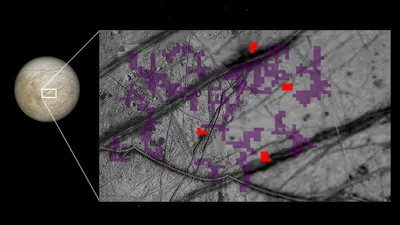
Ammonia-Bearing Compounds Discovered at Surface of Jupiter’s Moon Europa · Jan 29, 2026 · PIA26546 · Photo: NASA/JPL-Caltech 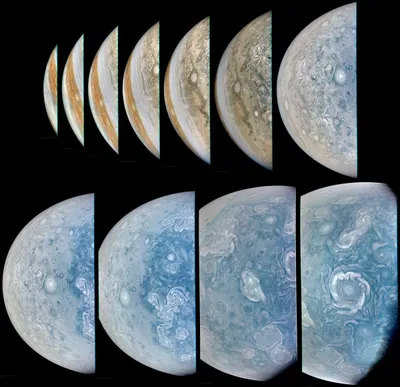
NASA’s Juno Mission Captures Close-Ups of Polar Storms on Jupiter · Jan 27, 2025 · PIA25730 · Photo: Image data: NASA/JPL-Caltech/SwRI/MSSS, Image processing by Brian Swift © CC BY 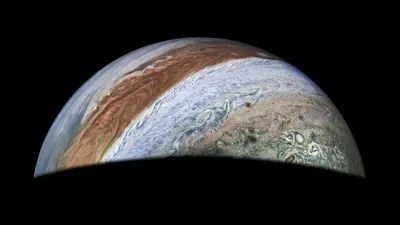
JunoCam Captures Jupiter on 62nd Flyby · Aug 20, 2024 · PIA26350 · Photo: Image data: NASA/JPL-Caltech/SwRI/MSSS, Image processing: Jackie Branc (CC BY) 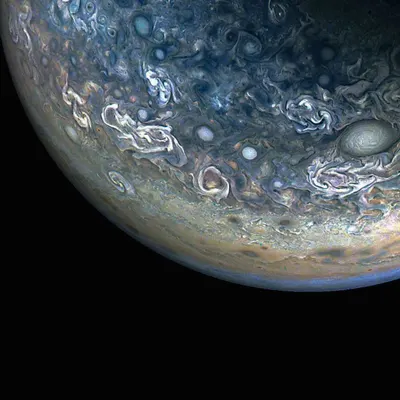
NASA’s Juno Mission Captures the Colorful and Chaotic Clouds of Jupiter · Jul 19, 2024 · PIA25729 · Photo: Image data: NASA/JPL-Caltech/SwRI/MSSS, Image processing by Gary Eason © CC BY 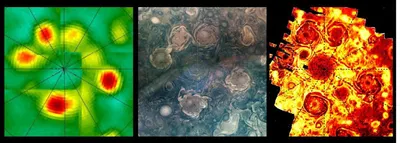
NASA’s Juno Catches 3 Waves of Jupiter’s Polar Cyclones · Apr 18, 2024 · PIA26295 · Photo: NASA/JPL-Caltech/SwRI/MSSS/ASI/INAF/JIRAM 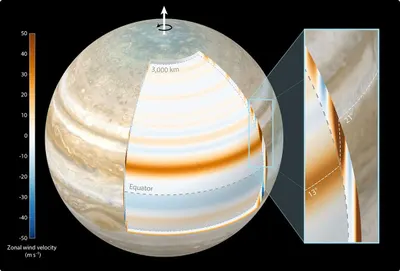
Cylindrical Orientation of Jupiter’s East-West Jet-Streams · Nov 9, 2023 · PIA26076 · Photo: NASA/JPL-Caltech/SSI/SWRI/MSSS/ASI/INAF/JIRAM/Björn Jónsson CC BY 3.0
NASA news about Jupiter
- NASA’s Juno Takes Temperature of Jupiter’s Fiery Moon Io
- Listen to This Month’s ‘Planetary Parade’ With NASA’s Chandra
- NASA’s Juno Measures Thickness of Europa’s Ice Shell
- Jupiter’s Volcanic Moon Io
- NASA’s Europa Clipper Radar Instrument Proves Itself at Mars
- NASA Shares How to Save Camera 370-Million-Miles Away Near Jupiter
Headlines from NASA’s news feeds (in English), updated daily. Last checked October 13, 2026.
Discoveries and exploration
Key moments in the study of Jupiter, each linked to its source.
- 1610Galileo Galilei discovers Jupiter's four largest moons, the first moons found beyond Earth. Source
- December 4, 1973Pioneer 10, NASA's first spacecraft to visit the outer planets, makes its closest approach to Jupiter. Source
- 1974Pioneer 11 flies even closer to Jupiter on its way to Saturn. Source
- March 1979Voyager 1 flies by and discovers a thin ring, two new moons and active volcanoes on Io. Source
- July 9, 1979Voyager 2 makes its closest approach to Jupiter. Source
- July 16, 1994Fragments of comet Shoemaker-Levy 9 begin striking Jupiter; the impacts end on July 22. Source
- December 7, 1995Galileo enters orbit around Jupiter, and its probe enters the planet's atmosphere. Source
- December 30, 2000Cassini passes about 9.7 million km from Jupiter's cloud tops on its way to Saturn. Source
- September 21, 2003Galileo is deliberately plunged into Jupiter to protect Europa, where it found signs of a possible ocean. Source
- July 4, 2016NASA's Juno spacecraft enters orbit around Jupiter. Source
- April 14, 2023ESA's JUICE launches to study Jupiter and its moons Ganymede, Callisto and Europa; arrival is planned for 2031. Source
- October 14, 2024NASA's Europa Clipper launches to study whether Europa has places below its surface that could support life. Source
Checked against the linked NASA, ESA and NOAA pages on October 10, 2026.
How to use this page
Choose your place and a night at the top: tonight by default, or one of the dates under it. The tiles show when Jupiter rises, is highest and sets, and the numbers that matter for that night. Below them you find where it is right now, the sky in 3D with Jupiter marked, finder charts, the year ahead and the facts.
What the numbers mean
- Rises and sets
- When the top edge of the disc meets a flat horizon, with the bending of light by the air included, as in almanacs. A time on another day carries its date.
- Highest
- When it crosses the meridian, due south or due north, and its height above the horizon then.
- Direction and height
- The compass point and azimuth to face, counted from north through east, and the angle above the horizon. A fist at arm’s length covers about 10°.
- Distance and apparent size
- How far away it is from Earth’s centre at that moment and how wide it looks in the sky, in arcminutes (′) or arcseconds (″).
- Magnitude
- Brightness: the smaller the number, the brighter. About 6 is the faintest the eye sees under a dark sky.
How accurate it is
Positions and times come from Astronomy Engine. In our tests positions agree with NASA JPL’s Horizons to within one arcminute, and rise and set times of the Sun and the Moon to within two minutes. Times assume a flat horizon at your place, so hills and buildings change when you actually see it rise or set. Methodology
Frequently asked questions
Why do the times change from night to night?
Earth turns once a day, and the body moves along its own path at the same time, so it rises and sets at a slightly different time each day. The Moon moves fastest and rises about 50 minutes later each day.
Why does a time show another date?
The page follows the night that starts on the evening of the chosen date. A rise, highest point or set after midnight belongs to the next date, so it carries that date.
Do the times include hills and buildings?
No. They are for a flat horizon. Hills, trees and buildings make a body rise later and set earlier than the page shows.
How do I find it in the sky?
Use the direction and height at its best time, then the finder charts further down to place it among the stars. The 3D sky shows it from your place at any time of the night.
Related guides
- How to find planets in the night skyFive planets are easy to see with the naked eye. Here is where to look, when, and how to recognise them.
- Opposition, conjunction and elongation explainedThree words from the planet calendar, and what they mean for when you can see each planet.
- Magnitude: how star brightness is measuredLower numbers mean brighter, and five magnitudes are a factor of 100 in brightness.
- Altitude and azimuth: finding things in the skyTwo angles tell you exactly where to look: which direction, and how high.
- Binoculars for stargazing: what to buy and what to look atA pair of 7x50 or 10x50 binoculars shows the craters of the Moon, the moons of Jupiter, dozens of star clusters and the Andromeda Galaxy, for a fraction of the cost of a telescope.