Earth history in 3D
Earth through time
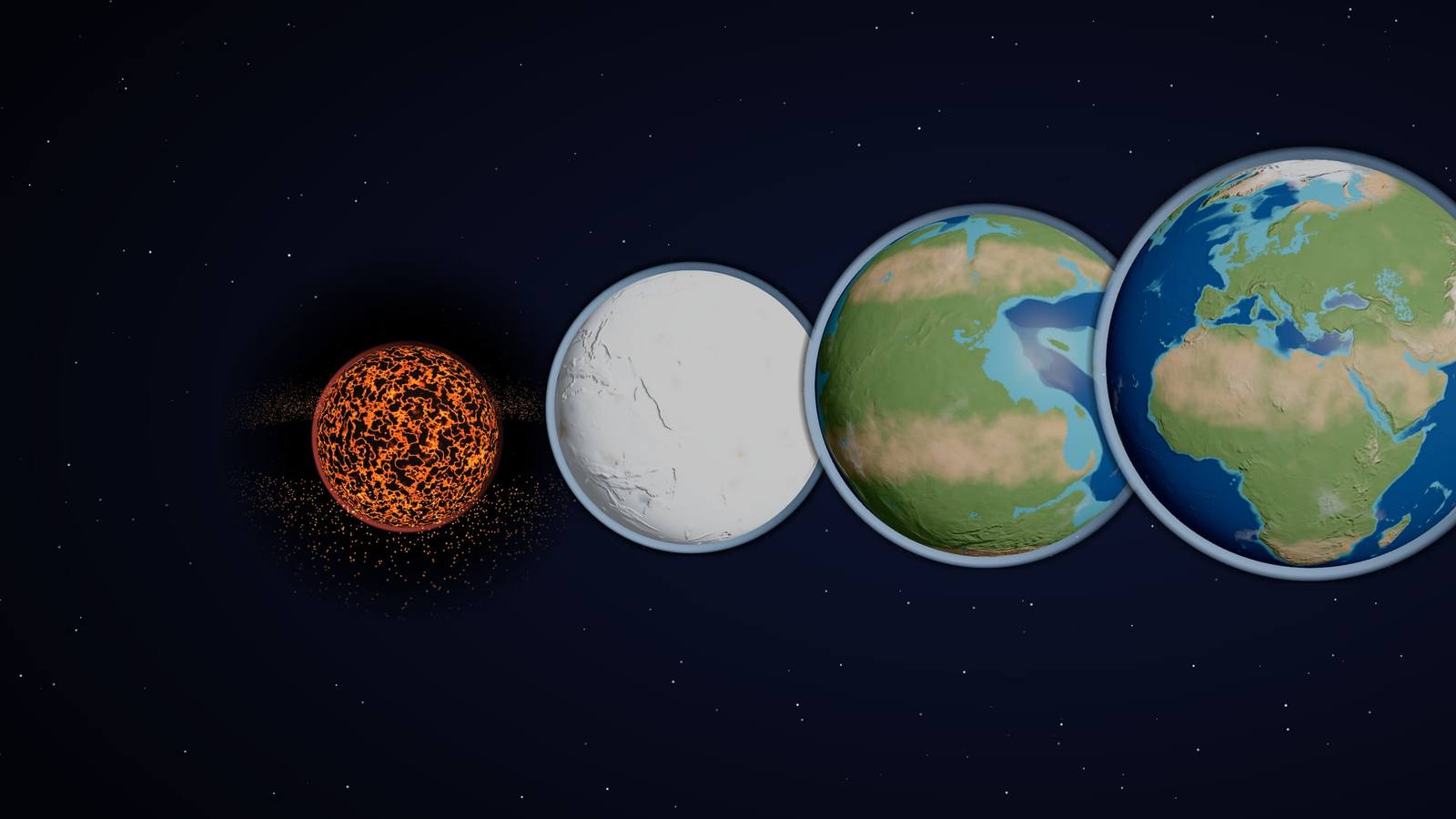
The Earth is about 4.54 billion years old. 250 million years ago nearly all the land was one supercontinent, Pangaea. Drag the timeline from the beginning of the universe to today and watch the planet form, freeze, split apart and drift, era by era.
Loading 3D view...
Today
Quaternary
Sun: 100% as bright as today
Today
The Earth as it is now, about 4.54 billion years after it formed.
Quaternary. Today
Reconstructed mapThe relief comes from the PALEOMAP maps by Scotese and Wright. The colours of land and ice are an impression.
Where was my place in Pangaea?
250 million years ago nearly all the land was joined in one supercontinent, Pangaea. The cities in the table lay at the latitudes shown then, carried back with their tectonic plates by the PALEOMAP plate model. The reconstruction is an estimate, so the latitudes are rounded to whole degrees. The zones use today’s tropics and polar circles.
| City | Latitude today | Latitude then | Zone by latitude then | Show on the globe |
|---|---|---|---|---|
| 52° N | 15° N | tropics | ||
| 49° N | 13° N | tropics | ||
| 53° N | 19° N | tropics | ||
| 40° N | 5° N | tropics | ||
| 42° N | 2° N | tropics | ||
| 46° N | 4° N | tropics | ||
| 41° N | 3° N | tropics | ||
| 42° N | 6° N | tropics | ||
| 19° N | 8° S | tropics | ||
| 23° S | 43° S | temperate zone | ||
| 30° N | 15° S | tropics | ||
| 34° S | 62° S | temperate zone | ||
| 19° N | 48° S | temperate zone | ||
| 34° S | 67° S | polar zone |
What the Earth looked like: Rodinia, Snowball Earth and Pangaea
Six moments as the explorer draws them. Pick one to see it on the globe.
Rodinia950 million years ago Snowball Earth700 million years ago Pangaea250 million years ago Pangaea breaks apart200 million years ago The asteroid strike66 million years ago Today
Geologic time scale: every eon, era and period
The official geological time scale (ICS International Chronostratigraphic Chart): eons, the eras within them and their periods, oldest first. Pick one to see it on the globe. The Hadean is counted from the first solids of the Solar System, a little before the Earth itself.
Named after the underworld: the young Earth is hot and struck again and again by debris left over from the planets' birth. Its molten surface cools to a first crust and the first oceans.
The first continents grow and the first life appears, as single cells. The air holds almost no oxygen.
For most of it life is only microbes. Early on oxygen starts to build up in the air, and near its end ice covers the planet and the first large complex organisms appear.
Oxygen made by microbes starts to build up in the air, the Great Oxidation Event.
A long, calm stretch sometimes called the boring billion, while the continents slowly gather into Rodinia.
Rodinia breaks apart, ice covers the planet at least twice, and the first large living things appear.
- 1 billion years ago to 720 million years ago
The supercontinent Rodinia holds most of the land, and it starts to break apart.
- 720 to 635 million years ago
Ice reaches the tropics: at least twice the whole planet may have frozen over, a Snowball Earth.
- 635 to 538.8 million years ago
After the ice, the first large living things made of many cells appear on the sea floor.
The eon of visible life: animals, plants and, at last, people.
The era of ancient life, from the Cambrian explosion to the largest mass extinction.
- 538.8 to 486.9 million years ago
Most of the main animal groups appear in a short time, the Cambrian explosion. Life is still in the sea.
- 486.9 to 443.1 million years ago
The seas teem with life and the first plants creep onto land. The period ends with an ice age and a mass extinction.
- 443.1 to 419.6 million years ago
Coral reefs spread in warm seas, and the first plants with stems that carry water grow on land.
- 419.6 to 358.9 million years ago
The age of fishes: the first forests grow, and the first animals with four legs step onto land.
- 358.9 to 298.9 million years ago
Vast swamp forests grow, and their remains become much of the coal mined today.
- 298.9 to 251.9 million years ago
Pangaea is fully formed. The period ends in the largest mass extinction known.
The age of reptiles, when the dinosaurs ruled the land.
- 251.9 to 201.4 million years ago
Life recovers on Pangaea, and the first dinosaurs and the first mammals appear.
- 201.4 to 143.1 million years ago
Pangaea splits apart and the Atlantic begins to open. Dinosaurs rule the land and the first birds appear.
- 143.1 to 66 million years ago
Flowering plants spread and dinosaurs are at their peak, until an asteroid strike ends their age.
The age of mammals, up to today.
- 66 to 23.04 million years ago
Mammals spread into the world the dinosaurs left. India runs into Asia and Antarctica freezes over.
- 23.04 to 2.58 million years ago
The continents reach nearly their shape of today, grasslands spread, and the first human ancestors walk upright in Africa.
- 2.58 million years ago to today
Ice ages come and go, and modern humans appear and spread across the world.
Earth history timeline: milestones
From the beginning of the universe to today, each with its source.
- 13.8 billion years agoSimulation
About 13.8 billion years ago the universe begins, extremely hot and dense, and starts to expand and cool.
Sources: Planck Collaboration (2020), Planck 2018 results VI
- 13.8 billion years agoSimulation
About 380,000 years after the start, the universe is cool enough for atoms to form and light travels freely. We still see that light as the cosmic microwave background.
Sources: NASA Webb: the early universe
- 13.5 billion years agoSimulation
After a dark age with no stars, the first stars and galaxies light up within a few hundred million years.
Sources: NASA Webb: the early universe
- 13 billion years agoSimulation
Our galaxy grows from smaller ones. Parts of it began forming about 13 billion years ago.
- 4.6 billion years agoSimulation
About 4.6 billion years ago a cloud of gas and dust collapses and the Sun lights up. The disc of dust around it will make the planets.
Sources: NASA: Our Sun, facts
- 4.54 billion years agoSimulation
Dust and rocks in the disc collide and grow into planets. The Earth is about 4.54 billion years old.
Sources: USGS: Age of the Earth
- 4.5 billion years agoSimulation
A body about the size of Mars, named Theia, smashes into the young Earth. Debris thrown into orbit gathers into the Moon, the leading explanation of its birth.
Sources: NASA: How the Moon formed
- 4.4 billion years agoIllustration
The surface cools. Crystals 4.4 billion years old from Western Australia show there was already crust and liquid water.
Sources: Wilde et al. (2001), Nature 409, 175
- 3.48 billion years agoIllustration
Layered mounds built by microbes 3.48 billion years ago in Western Australia are among the oldest signs of life.
Sources: Djokic et al. (2017), Nature Communications 8, 15263
- 2.4 billion years agoIllustration
About 2.4 billion years ago, oxygen made by microbes starts to build up in the air, the Great Oxidation Event.
Sources: Lyons, Reinhard and Planavsky (2014), Nature 506, 307
- 1 billion years agoPlate model
About 1 billion years ago most of the land is joined in a supercontinent, Rodinia. From here the continents follow a plate model.
- 717 million years agoPlate model
From 717 million years ago ice spreads to the equator, at least twice. The planet may have frozen almost entirely.
Sources: Hoffman et al. (2017), Science Advances 3, e1600983
- 575 million years agoPlate model
Soft, many-celled living things, some shaped like fronds and discs, appear on the sea floor.
Sources: Narbonne (2005), Annual Review of Earth and Planetary Sciences 33, 421
- 538.8 million years agoReconstructed map
From 538.8 million years ago most of the main animal groups appear. From here the map shows the reconstructed relief.
Sources: ICS International Chronostratigraphic Chart v2024/12
- 470 million years agoReconstructed map
Spores 470 million years old show the first plants growing on land, small and close to the ground.
Sources: Wellman, Osterloff and Mohiuddin (2003), Nature 425, 282
- 445 million years agoReconstructed map
Two pulses, as a short ice age begins and ends, wipe out most species in the sea, the first of the five great mass extinctions.
Sources: Bond and Grasby (2017), Palaeogeography, Palaeoclimatology, Palaeoecology 478, 3
- 385 million years agoReconstructed map
Trees with roots and wood grow into the first forests, about 385 million years ago.
- 372 million years agoReconstructed map
A second mass extinction strikes life in the sea, reef builders among it.
Sources: Bond and Grasby (2017), Palaeogeography, Palaeoclimatology, Palaeoecology 478, 3
- 251.9 million years agoReconstructed map
At the end of the Permian the largest mass extinction known wipes out most living species.
Sources: Bond and Grasby (2017), Palaeogeography, Palaeoclimatology, Palaeoecology 478, 3, ICS International Chronostratigraphic Chart v2024/12
- 250 million years agoReconstructed map
Nearly all the land is joined in one supercontinent, Pangaea, surrounded by one ocean, Panthalassa.
Sources: USGS: This Dynamic Earth, historical perspective, Scotese and Wright (2018), PALEOMAP PaleoDEMs
- 230 million years agoReconstructed map
The first dinosaurs appear, small and walking on two legs, about 230 million years ago.
Sources: Brusatte et al. (2010), Earth-Science Reviews 101, 68
- 201.4 million years agoReconstructed map
A mass extinction clears the way for the dinosaurs to rule the land.
Sources: Bond and Grasby (2017), Palaeogeography, Palaeoclimatology, Palaeoecology 478, 3, ICS International Chronostratigraphic Chart v2024/12
- 200 million years agoReconstructed map
About 200 million years ago Pangaea starts to break apart, and the oceans of today begin to open.
- 66 million years agoReconstructed map
66 million years ago an asteroid hits what is now Mexico. The dinosaurs, except the birds, die out.
Sources: ICS International Chronostratigraphic Chart v2024/12, Schulte et al. (2010), Science 327, 1214
- 50 million years agoReconstructed map
India runs into Asia and the Himalayas start to rise, 40 to 50 million years ago.
- 34 million years agoReconstructed map
About 34 million years ago a great ice sheet starts to grow on Antarctica.
- 2.58 million years agoReconstructed map
From 2.58 million years ago ice sheets grow and shrink again and again over the northern continents.
Sources: ICS International Chronostratigraphic Chart v2024/12
- 300,000 years agoReconstructed map
Fossils about 300,000 years old from Morocco are among the oldest of our species, Homo sapiens.
- TodayReconstructed map
The Earth as it is now, about 4.54 billion years after it formed.
How it works
The timeline is not to scale: the 9 billion years before the Earth and its first 4 billion years are squeezed together, so the last 540 million years, where the maps are, get more than half of it. Before the Earth the view is a simulation. The young Earth is an illustration. From 1,000 million years ago the continents follow the PALEOMAP plate model, and from 540 million years ago the relief comes from the PALEOMAP maps, one every 5 million years, blended in between. Your place is carried back with its plate by the same model, on your device.
Paleogeography: C. R. Scotese and N. Wright (2018), PALEOMAP Paleodigital Elevation Models; plate model: C. R. Scotese (2016), PALEOMAP PaleoAtlas for GPlates · ICS International Chronostratigraphic Chart v2024/12 · Data sources
Frequently asked questions
Where was my country in Pangaea?
250 million years ago, in the PALEOMAP plate model, London lay at about 15° N, New York at about 3° N and Sydney at about 67° S. For any other place, pick A place then above the globe: it is carried back with its plate to the time on the timeline.
How old is the Earth?
About 4.54 billion years, according to the USGS, from the ages of meteorites and of the lead in the Earth’s oldest ores.
When did Pangaea exist?
Pangaea joined nearly all the land in the late Paleozoic and early Mesozoic. It began to break up about 225 to 200 million years ago, and the Atlantic opened as it split.
What did the Earth look like when the dinosaurs lived?
When the first dinosaurs appeared, about 230 million years ago in the Triassic, nearly all the land was one supercontinent, Pangaea. It broke apart through the Jurassic and Cretaceous, so by the asteroid strike 66 million years ago the land had split into today’s continents, but India was still an island far to the south, Australia was still joined to Antarctica and the Atlantic was much narrower.
What was Rodinia?
A supercontinent that joined most of the land about 1 billion years ago. It started to break apart in the Tonian period, which lasted from 1 billion to 720 million years ago.
What was Snowball Earth?
A time when ice reached the equator and the planet may have frozen almost entirely. It happened at least twice in the Cryogenian: the Sturtian glaciation, from 717 to about 659 million years ago, and the Marinoan, which ended 635 million years ago.
Where was my town millions of years ago?
Pick A place then above the globe and search for your town, or use your saved place: it is carried back with its tectonic plate by the PALEOMAP plate model, as far as 1,000 million years, and the note below the globe gives its latitude at the time. It works on your device, and your place is not sent anywhere.
How accurate are the maps?
They are reconstructions: the PALEOMAP maps by Scotese and Wright estimate the land and sea every 5 million years back to 540 million years. Before that the continents are placed with the plate model, with today’s outlines and rough positions for times older than about 750 million years, the young Earth is an illustration, and the time before the Earth is a simulation, as the view says.