Asteroid impact simulator
Choose an asteroid, pick any spot on Earth, your own city too, and launch it. The rings show how far each effect would reach, worked out with the equations scientists use to estimate impacts, and how many people live inside them.
Loading 3D view...
Keys: Space plays or pauses, R restarts, F follows the asteroid. The timeline’s clock is real time since the impact, shown faster and faster.
Pick an asteroid and a place, then press Launch.
The rings are first-order estimates from the Earth Impact Effects Program (Collins, Melosh and Marcus, 2005), which builds on nuclear test data and impact research. Real effects depend on the ground, the weather and the buildings. People: GHS-POP 2025 from the European Commission’s Joint Research Centre, in cells about 4.6 km wide. Deaths: the expected case of the vulnerability models by Rumpf, Lewis and Atkinson (2017), for people where they live, without warning. Each effect is counted on its own, the total once per person. Timing: the fireball radiates most at its radius over the impact speed and for as long as its heat takes to escape (Collins et al. 2005, Eqs. 33 and 35). The shaking travels at about 5 km/s and the air blast at the speed of sound (Eqs. 42 and 64).
What each size of asteroid would do
A stony asteroid hitting land at 20 km/s and 45 degrees, worked out with this simulator’s model. Small ones burst in the air, bigger ones reach the ground slowed by the air and dig a crater, and above a few hundred metres the damage grows quickly with size.
| Diameter | Energy at entry | Outcome | Wooden houses collapse up to | Happens about once every |
|---|---|---|---|---|
| 50 m | 9 Mt | airburst 7.6 km up | 16 km | 630 years |
| 100 m | 75 Mt | crater 1.6 km wide | 11 km | 3,200 years |
| 300 m | 2,000 Mt | crater 5.3 km wide | 61 km | 41,000 years |
| 1 km | 75,000 Mt | crater 16 km wide | 210 km | 690,000 years |
| 10 km | 75,000,000 Mt | crater 120 km wide | 2,100 km | 150,000,000 years |
Famous impacts and what they would do
The impact scenarios worked through in the paper behind this simulator, and Bennu, the asteroid NASA’s OSIRIS-REx sampled, with its size and impact speed from NASA’s impact monitoring.
Tunguska-size airburst, 75 m
It happenedEarly on 30 June 1908 an object between 50 and 100 m across exploded about 6 to 10 km above a remote part of Siberia. It toppled and scorched trees across hundreds of square kilometres but left no crater.
- Energy at entry
- 15 Mt
- Outcome
- airburst 4.8 km up
- Wooden houses collapse up to
- 18 km
- Windows shatter up to
- 41 km
- Happens about once every
- 910 years
Meteor Crater-size iron, 40 m
It happenedAbout 50,000 years ago an iron meteorite hit northern Arizona and dug Meteor Crater, a bowl about 1.2 km across and 180 m deep.
- Energy at entry
- 13 Mt
- Outcome
- crater 1.2 km wide
- Wooden houses collapse up to
- 7.4 km
- Windows shatter up to
- 17 km
- Happens about once every
- 800 years
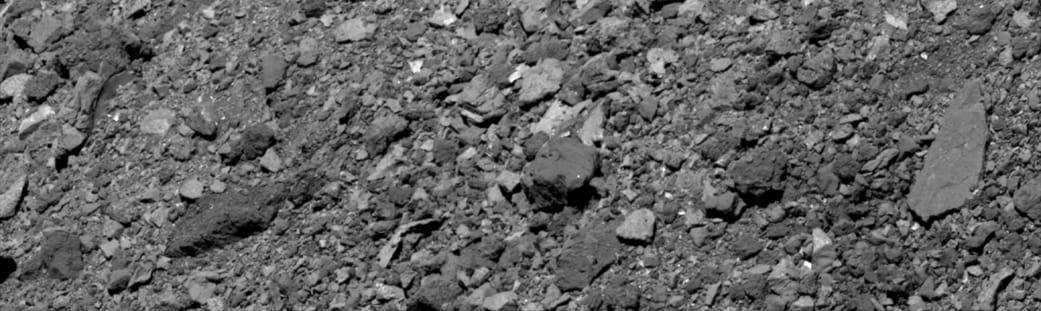
Bennu, 490 m
If it hitA near-Earth asteroid about 490 m across. NASA’s OSIRIS-REx spacecraft brought a sample of it back to Earth in 2023. NASA/JPL’s Sentry puts its chance of hitting Earth by the year 2300 at about 1 in 1,750, so this row shows what it would do, not something that happened.
- Energy at entry
- 1,400 Mt
- Outcome
- crater 4.5 km wide
- Wooden houses collapse up to
- 54 km
- Windows shatter up to
- 130 km
- Happens about once every
- 31,000 years
Ries crater-size, 1.75 km
It happenedAbout 14.8 million years ago an asteroid hit what is now Bavaria in southern Germany. Its crater, the Nördlinger Ries, is about 24 km across, and the town of Nördlingen stands inside it.
- Energy at entry
- 360,000 Mt
- Outcome
- crater 24 km wide
- Wooden houses collapse up to
- 360 km
- Windows shatter up to
- 840 km
- Happens about once every
- 2,400,000 years
Try it in the simulatorSources: EosChicxulub-size, 18 km
It happenedAbout 66 million years ago an asteroid or comet hit what is now the Yucatán Peninsula in Mexico, then under a shallow sea. Its crater, about 180 km across, lies buried under limestone. The impact and its aftermath killed off about three quarters of life on Earth, the dinosaurs among it.
- Energy at entry
- 390,000,000 Mt
- Outcome
- crater 190 km wide
- Wooden houses collapse up to
- 3,700 km
- Windows shatter up to
- 8,600 km
- Happens about once every
- 550,000,000 years
How it works
The simulator follows the asteroid through the atmosphere: strong enough bodies reach the ground, weaker ones break up and spread out until they explode in the air. From the energy left, it works out the crater, the fireball and the heat it radiates until the Earth’s curve hides it, the shock wave in the air with the wind behind it, and the shaking of the ground. Each ring marks the farthest distance where an effect reaches a threshold taken from nuclear test data or earthquake records. For each ring it counts the people who live inside it from a world population grid.
What it leaves out
The model treats the asteroid as one body on a straight path, the air as a simple layered atmosphere and the ground as flat beyond the horizon’s effect on the heat. It does not estimate tsunamis, the global cooling or fires that a very large impact would cause, or what people do to shelter. The population inside a ring says how many people live there, not how many would be hurt.
Model: Collins, Melosh and Marcus (2005), Meteoritics & Planetary Science 40, 817–840.Population: GHS-POP R2023A, European Commission JRC (CC BY 4.0).Bennu: NASA/JPL Sentry impact monitoring.Deaths: Rumpf, Lewis and Atkinson (2017), Meteoritics & Planetary Science 52, 1082–1102.Lungs and eardrums: NATO Handbook on the Medical Aspects of NBC Defensive Operations (US Army FM 8-9).Data sources
Frequently asked questions
How big does an asteroid have to be to destroy a city?
In this simulator, a stony asteroid about 50 m across, entering at 20 km/s and 45 degrees, explodes 7.6 km above the ground and flattens wooden houses up to 16 km away, enough to destroy a city. Smaller ones break up higher in the air and do less damage on the ground.
What would happen if a 1 km asteroid hit Earth?
Hitting land at 20 km/s and 45 degrees, a stony asteroid 1 km across would release about 75,000 megatons of TNT, leave a crater about 16 km wide, flatten wooden houses up to 210 km away and break windows up to 490 km away. The ground would shake like a magnitude 7.9 earthquake. An impact this energetic happens about once every 690,000 years.
How often do asteroids hit Earth?
The bigger the impact, the rarer it is. By the impact rate this simulator uses (Collins, Melosh and Marcus, 2005), an impact as energetic as a stony asteroid 50 m across happens about once every 630 years, 1 km across about once every 690,000 years and 10 km across about once every 150,000,000 years.
Is an asteroid going to hit Earth?
No known large asteroid is on course to hit Earth. NASA’s Planetary Defense Coordination Office says that no known asteroid larger than 140 metres has a significant chance of hitting Earth in the next 100 years, though many of that size are still to be found. NASA/JPL’s Sentry system lists the known asteroids with any chance of hitting Earth in the next 100 years, with their odds.
How accurate is the simulator?
Its rings are first-order estimates worked out with the equations of the Earth Impact Effects Program by Collins, Melosh and Marcus (2005), which builds on nuclear test data and impact research, with injury thresholds from the US Army and death rates from Rumpf and colleagues (2017). Real effects would depend on the ground, the weather, the buildings and the asteroid’s exact shape and strength, so take each distance as a rough guide, not a forecast.
Why is there no crater or tsunami for an impact at sea?
At sea the crater and the shaking would depend on the water’s depth, so the simulator does not estimate them, and it leaves out tsunamis. The fireball, the shock wave and the wind are still worked out.
Can I see an impact on my own city?
Yes. Click or tap the globe or the street map where the asteroid should hit, or use the target button to go to your saved place. When you pick the spot on the globe or the map, the link in the address bar keeps the asteroid and the place, so you can share it. Your saved place is never put in the link.